School Partnership Programs for Integrating Abacus into Math Curriculum
🏫 Introduction: The Abacus Advantage in Schools
Schools worldwide are discovering that abacus training isn’t just an after-school activity – it can be seamlessly integrated into the regular math curriculum. Partnership programs provide ready-to-use lesson plans, teacher training, and certification pathways. In this guide, I’ll show school administrators and educators how to launch a successful abacus program that boosts math scores, student confidence, and parent satisfaction.
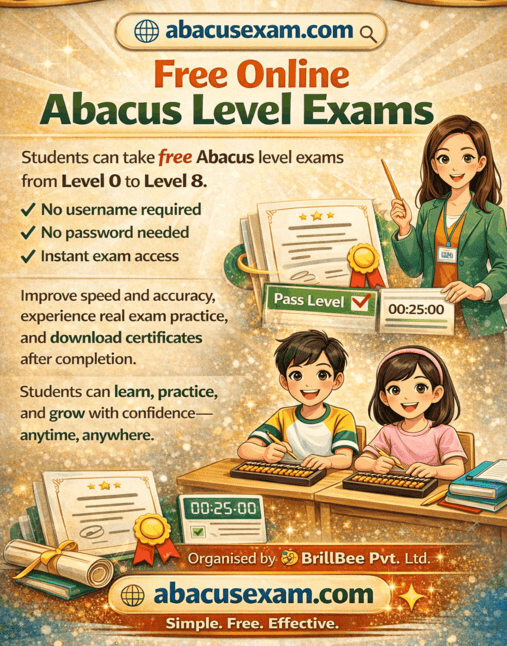
Students who want to improve their calculation speed and accuracy can also do regular practice. You can try abacus practice, abacus exams, and 1-minute mental math challenges here: Practice on Brillbee Academy
📉 Problem: Math Fluency Gap in Traditional Teaching
Many students can follow algorithms but lack calculation fluency. They depend on fingers or calculators for basic arithmetic. Standard textbooks don’t provide systematic speed-building drills. The result: slow test performance, math anxiety, and weak number sense. Abacus integration fills this gap by building mental math speed as a foundational skill.
🤝 What Is a School-Abacus Partnership Program?
A structured collaboration between an abacus training provider (like abacusexam.com) and a school. The provider supplies: curriculum maps, instructor manuals, teacher training, student workbooks, abacus kits, assessment tools, and certification exams. The school allocates class time (e.g., 30 minutes, 3 times per week) and designates a coordinator. Some models use external abacus trainers, others train existing math teachers.
📝 Step-by-Step: Launching a Partnership
Step 1: School expresses interest – free consultation with abacus provider. Step 2: Pilot program with one grade (e.g., Grade 2) for 3 months. Step 3: Provider trains 2-3 school teachers (2-day workshop). Step 4: Provider delivers abacus kits, workbooks, and digital resources. Step 5: Weekly 30-min sessions integrated into math period. Step 6: Monthly assessments and parent reports. Step 7: After pilot, scale to more grades.
🌟 Real School Success Stories
Delhi Public School (India) integrated abacus into Grades 2-4. After 6 months, average math test scores increased by 22%. Students’ calculation speed for 2-digit addition improved from 15 seconds to 6 seconds per sum. Another example: A charter school in California used our partnership model – within one academic year, 85% of students met or exceeded state math fluency benchmarks.
✅ Benefits of Abacus-School Partnership
- 📊 Improves school-wide math scores – measurable ROI.
- 🧠 Enhances cognitive skills beyond math (memory, focus).
- 👩🏫 Empowers teachers with new, effective tools.
- 🏆 Offers students internationally recognized abacus certifications.
- 📈 Differentiates your school from competitors.
- 💰 Cost-effective – low investment, high impact.
📚 Curriculum Alignment & Teacher Training – Deep Dive
Our partnership program aligns abacus levels with school math standards (Common Core, CBSE, ICSE, etc.). For example, when a class learns addition with carrying in textbooks, the abacus lesson reinforces the same concept using small friend formulas. Teacher training covers: bead manipulation, mental visualization techniques, error diagnosis, and classroom management for speed drills. We also provide ongoing support via monthly webinars.
⭐ Expert Tips by Ashwani Sharma
- 📌 Start with a pilot in lower grades (2-3) for fastest adoption.
- 📌 Ensure each student has their own abacus – sharing reduces practice time.
- 📌 Schedule abacus sessions in the morning when focus is highest.
- 📌 Appoint an abacus coordinator within the school for smooth communication.
- 📌 Display speed charts in classrooms to motivate students.
- 📌 Involve parents via demo days and take-home practice sheets.
- 📌 Measure success not just by speed but also by student engagement surveys.
✅ Do’s and ❌ Don’ts for School Abacus Integration
Do’s: Do integrate abacus with existing math topics. Do train teachers before launch. Do celebrate small wins with certificates. Do allow flexible pacing for different learners. Do collect data before and after.
Don’ts: Don’t treat abacus as an “extra” – integrate it. Don’t force all grades at once. Don’t skip teacher refresher courses. Don’t use low-quality abacus kits. Don’t ignore students who struggle – provide remedial support.
📈 Expected Academic Outcomes (12-Month Timeline)
- ✨ Month 1-2: Students show improved finger dexterity and basic addition speed.
- ✨ Month 3-4: 40% reduction in calculation errors on school tests.
- ✨ Month 5-6: Average mental math speed doubles compared to control group.
- ✨ Month 7-9: Improved scores in word problems (less cognitive load).
- ✨ Month 10-12: School-wide math percentile rank increases by 15-25 points.
❌ Common Mistakes Schools Make
- 1. Expecting immediate results – abacus takes 3 months to show impact.
- 2. Not providing enough practice time (less than 20 min/week is ineffective).
- 3. Using untrained teachers – abacus requires specific hand techniques.
- 4. Focusing only on speed, not accuracy – creates bad habits.
- 5. No parent communication – parents need to support home practice.
- 6. Stopping program after one semester – long-term commitment needed.
Learn more about our complete school implementation guide and abacus teacher certification courses.
❓ FAQs for School Administrators
Q1: What is the cost of a school partnership program?
A: Varies by scale. Typically $15–$25 per student per term, including kits and training.
Q2: How many hours per week are needed?
A: Minimum 90 minutes per week (e.g., three 30-min sessions).
Q3: Do we need to hire new teachers?
A: No – we train your existing math teachers. Optional external trainers available.
Q4: What grades benefit most?
A: Grades 2-5 see the fastest cognitive gains. Can be extended to K-8.
Q5: Is the curriculum aligned with national standards?
A: Yes, we map to Common Core, CBSE, ICSE, IGCSE, and others.
Q6: How do we measure program success?
A: Pre- and post- speed tests, math exam scores, and student surveys.
Q7: Can we start mid-academic year?
A: Yes, we provide accelerated onboarding.
🚀 Bring Abacus Excellence to Your School!
Request a free consultation and pilot program proposal. Transform math outcomes today.
📞 Call/WhatsApp: +91 96641 11853📌 Summary: A Win-Win Partnership
Integrating abacus into your school’s math curriculum through a structured partnership program boosts student performance, teacher effectiveness, and school reputation. With proper training, resources, and commitment, you can close the math fluency gap and give students a lifelong cognitive advantage.