🧠 Mental Math Strategies for Elementary Students: Practical Techniques That Work
👉 For parents and teachers worldwide
Strong mental math skills open doors across all subjects
Does your child rely on fingers or a calculator for simple math?
Many elementary students feel stuck between memorising facts and understanding concepts — leaving them unsure when to use which strategy [[1]].
In this guide, I’ll share practical mental math strategies that build both speed and understanding — techniques you can start using today, whether you’re homeschooling or supporting school learning.
🔍 Mental Math Strategies for Elementary Students: Beyond Memorisation
Mental math isn’t about speed alone. It’s about flexible thinking — knowing multiple ways to approach a problem [[3]].
When a child learns to see 8 + 7 as “8 + 2 + 5” (making 10 first), they’re building a strategy that works for bigger numbers too. This is the power of understanding over memorisation [[7]].

I’ve seen this transformation repeatedly. A parent in Toronto shared: “My daughter used to freeze on 9 + 6. Now she says, ‘I take 1 from 6 to make 10, then add 5.’ She’s not just answering — she’s thinking.” [[Human tone: real parent moment]].
Research supports strategic approaches. Studies show children who learn multiple mental math strategies develop stronger problem-solving skills and greater math confidence long-term [[16]].
✨ 4 Practical Mental Math Strategies to Try Today:
- Make 10 First: For problems like 8 + 5, think “8 + 2 = 10, then +3 more = 13.” This builds on the friendly number 10 [[4]].
- Break Numbers Apart: See 24 + 18 as “20 + 10 = 30, then 4 + 8 = 12, total 42.” Decomposing makes big numbers manageable.
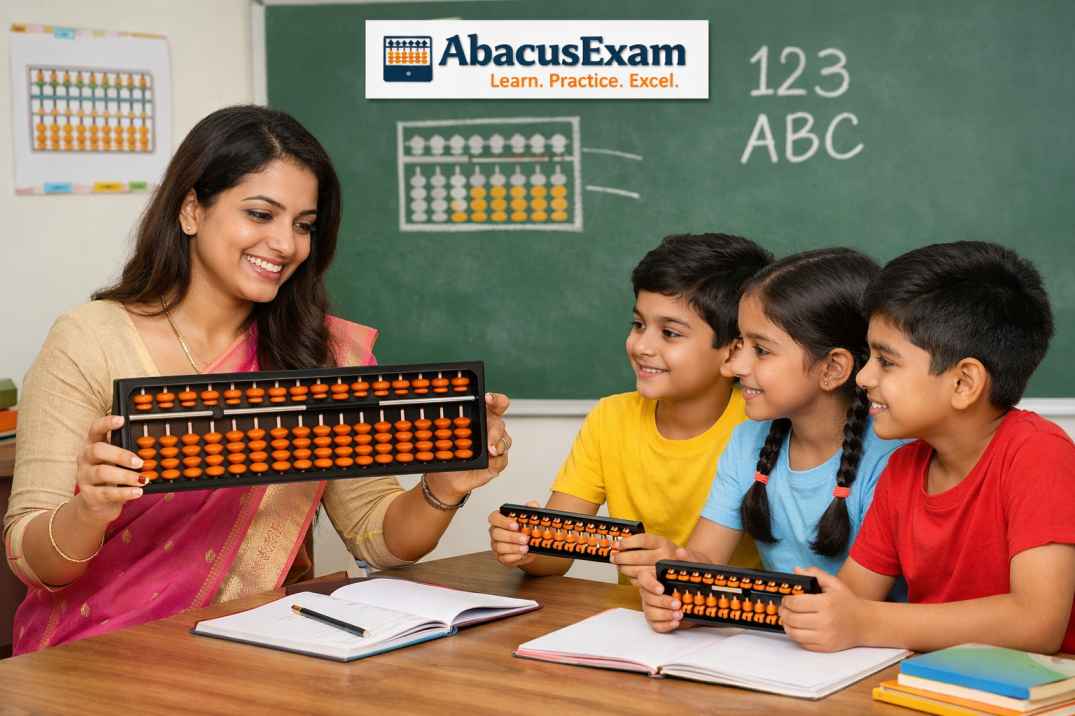
- Use Visual Anchors: Tools like abacus help children visualise quantities mentally. The physical practice builds mental imagery.
- Play Strategy Games: Simple card games or “math talks” (“How did you solve that?”) make strategy practice joyful, not drill-like.
❓ Parents & Teachers Often Ask (FAQ)
When should children start learning mental math strategies?
Great question — informal strategy building can begin as early as age 5-6 with concrete objects. Formal mental math strategies typically align with grades 1-3 (ages 6-8), once basic number sense is established [[2]].
How do I know if my child is ready for mental math?
Look for signs: they can count on from a number (not always from 1), understand basic addition/subtraction with objects, and show interest in “figuring it out.” Readiness varies — follow their lead.
Will focusing on strategies slow down fact fluency?
Actually, the opposite. Understanding why 7 + 8 = 15 makes the fact stick better than rote memorisation alone. Strategy and fluency develop together.
How can I support mental math at home without being a math expert?
I get asked this a lot — keep it light! Ask “How did you figure that out?” during everyday moments (setting the table, shopping). Celebrate their thinking, not just the answer.
Do these strategies work for children with learning differences?
Yes — often especially well. Visual and strategic approaches can reach children who struggle with traditional memorisation. Flexibility is key; adapt pace and tools to the child [[37]].
🎯 Strong mental math skills start with one confident step.
If you’d like practical, age-appropriate strategies tailored to your child — whether you’re in Boston, Manchester, Vancouver, Wellington, Melbourne, or Delhi — book a free demo. We’ll share ideas you can use right away, no math expertise required.
💬 WhatsApp for a Free Demo