How can teachers integrate abacus in classrooms?

Introduction
If you’ve ever wondered how can teachers integrate abacus in classrooms without disrupting existing lesson plans, you’re not alone. Around the world—from the USA and UK to Australia, UAE, Norway, Czechia, and India—educators are searching for practical ways to rebuild math confidence in students.
I’m Ashwani Sharma, Director of Mission Abacus Private Limited, based in Jaipur, India. Over the years, I’ve worked closely with teachers, parents, and schools across different education systems. One concern keeps coming up: children are losing comfort with numbers.
Abacus is not a replacement for school mathematics. It’s a thinking tool. When integrated thoughtfully, it strengthens mental calculation, focus, and numerical clarity—skills that matter in both traditional and hybrid classrooms.
Let’s explore how this can be done realistically and effectively.
Table of Contents
- Why Abacus Belongs in Modern Classrooms
- How can teachers integrate abacus in classrooms effectively?
- Structuring Abacus Within School Timetables
- Supporting Different Age Groups
- The Role of Parental Involvement in Abacus
- Experience-Based Insights from Classrooms
- When Abacus May Not Be Enough
- Benefits for Students, Parents, and Teachers
- Frequently Asked Questions
- Conclusion
Why Abacus Belongs in Modern Classrooms
Education has changed dramatically.
We now see:
- Online learning growth
- Hybrid education models
- Screen fatigue among students
- Cross-border tutoring
- Increasing math confidence gaps
Children often rely heavily on calculators and digital tools. While technology is helpful, early dependency reduces mental flexibility.
Abacus brings learning back to tactile and visual engagement. It activates both sides of the brain and encourages structured thinking.
In my experience working with students, the biggest transformation isn’t speed. It’s confidence.
How can teachers integrate abacus in classrooms effectively?
This is where many educators hesitate.
They worry about time, curriculum alignment, and training requirements.
The good news? Integration doesn’t require overhauling the syllabus.
1. Start With Short Mental Math Blocks
Dedicate 10–15 minutes, two or three times per week.
These sessions can include:
- Basic bead movement practice
- Visualization drills
- Speed exercises
- Oral calculation challenges
Over the years, I’ve noticed that consistency matters more than duration.
2. Use Abacus as a Warm-Up Tool
Before math class begins, teachers can use abacus as a cognitive warm-up.
Just like stretching prepares muscles, abacus prepares the brain.
Students become more attentive and responsive during the core math lesson.
3. Align With Curriculum Objectives
Teachers often ask whether abacus conflicts with school math.
For clarity, you may find this helpful resource on whether abacus helps in school mathematics performance:
https://abacusexam.com/can-abacus-help-in-school-maths/
Abacus strengthens number sense, place value understanding, and arithmetic accuracy—core elements in international exam structures.

Structuring Abacus Within School Timetables
Integrating abacus practice into weekly lesson plans
Abacus works well in:
- Grades 1–5 foundational math blocks
- Enrichment periods
- After-school clubs
- Homeschool settings
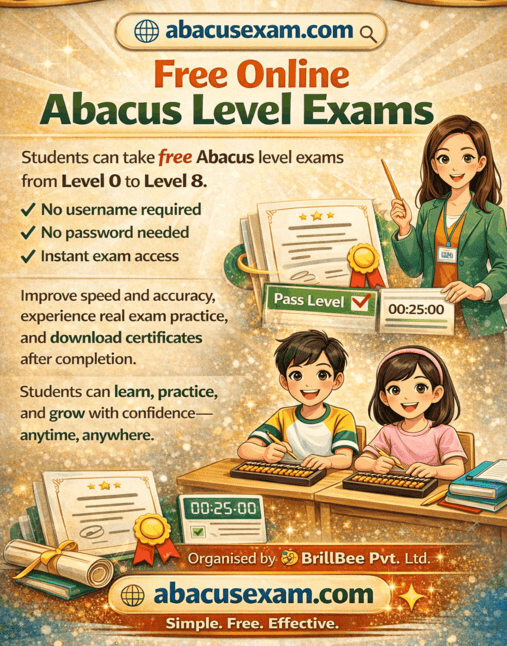
It can also support students preparing for structured level exams. For teachers guiding students through progressive evaluation systems, understanding abacus exam duration and time management tips can be helpful:
https://abacusexam.com/abacus-exam-levels-explained-beginner-to-advanced/
Structured levels create measurable progress without pressuring children.
Students who practice regularly, appear for level exams, and participate in competitions show faster improvement in speed, accuracy, and confidence.
Supporting Different Age Groups Through Abacus
Abacus integration in early primary classrooms
Young learners respond well to physical tools.
At this stage:
- Focus on bead familiarity
- Reinforce place value
- Use rhythm and repetition
How abacus builds early number sense
Children begin to “see” numbers rather than memorize them.
This strengthens long-term retention.
Abacus for middle-grade learners
At ages 8–12:
- Visualization techniques expand
- Speed improves naturally
- Confidence in multi-digit calculations grows
Teachers can combine abacus drills with word problems to strengthen comprehension.
For a broader understanding of student development benefits, this overview on Abacus benefits for students offers helpful insight:
https://abacusexam.com/abacus-benefits-for-students/
The Role of Parental Involvement in Abacus
No classroom effort succeeds in isolation.
Parental involvement in abacus significantly influences progress.
Parents don’t need to become instructors. They simply need to:
- Encourage regular practice
- Celebrate small milestones
- Reduce performance pressure
Supporting children in mental math at home
Simple steps help:
- 10 minutes of daily practice
- Weekly review conversations
- Balanced expectations
Family support in abacus learning builds emotional safety.
Children who feel supported perform better.
Parent guidance in abacus training
Teachers can organize:
- Orientation sessions
- Demo classes
- Monthly progress updates
This builds alignment between school and home.
Let me ask you something.
When was the last time a student said, “I enjoy solving math problems”?
Abacus often brings back that spark.

Experience-Based Insights From Classrooms
In my experience working with students across different education systems, one pattern is clear:
Students struggling with math rarely lack intelligence.
They lack clarity.
Abacus slows down the learning process initially. That feels uncomfortable in fast-paced academic systems.
But once understanding develops, speed follows naturally.
Over the years, I’ve noticed that schools that integrate abacus early face fewer math anxiety issues later.
When Abacus May Not Be Enough
It’s important to remain balanced.
Abacus strengthens arithmetic skills.
However:
- It does not replace conceptual algebra instruction.
- It does not automatically improve geometry reasoning.
- It cannot solve motivational issues alone.
Teachers must combine it with:
- Concept-based teaching
- Real-world applications
- Emotional encouragement
Abacus is a foundation tool—not a full curriculum.
Addressing Global Learning Realities
Today’s classrooms are international.
Students attend:
- Physical schools
- Online academies
- Hybrid programs
- Cross-border tutoring platforms
Screen fatigue is real.
Many children spend hours on digital devices.
Abacus offers a screen-free learning method.
It restores tactile engagement.
In global contexts where students prepare for competitive and standardized exams, structured mental calculation becomes an advantage.
Some educators refer families to comprehensive systems such as the All-in-One Abacus Learning System available at:
https://abacusshiksha.com
Such systems can complement classroom instruction when used thoughtfully.
Benefits of Integrating Abacus in Classrooms
For Students
- Improved concentration
- Faster calculation speed
- Reduced math anxiety
- Stronger working memory
- Better exam time management
Students develop calm confidence.
For Parents
- Clear measurable progress
- Structured learning pathway
- Greater parental involvement in abacus
- Visible improvement in school performance
Family support in abacus learning strengthens trust between school and home.
For Teachers
- Engaged classrooms
- Improved numerical fluency
- Better participation
- Reduced repetitive arithmetic errors
Teachers often report smoother transitions into advanced math topics.
Practical Classroom Implementation Plan
If you’re wondering again, how can teachers integrate abacus in classrooms without overwhelming students, here’s a simple roadmap:
- Start with pilot groups.
- Train one or two teachers first.
- Introduce weekly practice blocks.
- Measure progress through internal assessments.
- Gradually expand.
Small beginnings often create sustainable systems.
Frequently Asked Questions
Can abacus be introduced in regular school hours?
Yes. Many schools integrate 10–15 minute sessions within math periods. It enhances focus rather than consuming excessive time.
Is it worth integrating abacus in hybrid classrooms?
Absolutely. In fact, hybrid learning increases the need for structured mental engagement away from screens.
How long does it take to see improvement?
With regular practice, noticeable improvement appears within 3–6 months. Speed develops gradually.
Can older students start learning abacus?
Yes. While early introduction is ideal, middle-grade students also benefit from visualization techniques.
Does abacus replace calculators?
No. Calculators are tools. Abacus builds mental foundation. Both have their place.
Is parental involvement in abacus necessary?
It isn’t mandatory, but parental involvement in abacus significantly improves consistency and motivation.
Conclusion
Integrating abacus into classrooms isn’t about adding pressure.
It’s about restoring balance.
Children today face screen fatigue, exam stress, and math confidence gaps. Teachers are navigating hybrid education systems and international standards.
Abacus provides structure.
It provides rhythm.
It provides clarity.
As educators, we don’t just teach numbers. We build thinking habits.
If introduced thoughtfully, patiently, and consistently, abacus becomes more than a tool—it becomes a mindset.
Warm regards,
Ashwani Sharma
Let’s continue building confident learners, one step at a time. 🌿📘