🏆 Will Abacus Education Give Your Child an Edge in Competitive Exams?
Quickly jump to any section 👇
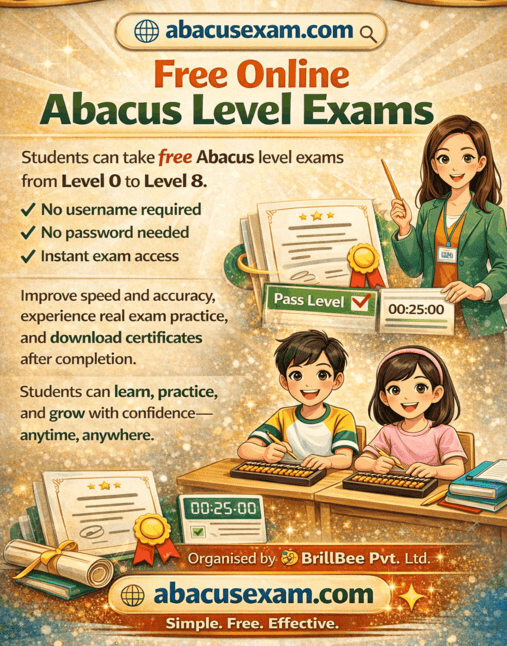
Students who want to improve their calculation speed and accuracy can also do regular practice. You can try abacus practice, abacus exams, and 1-minute mental math challenges here: Practice on Brillbee Academy
🌟 Introduction: The Competitive Exam Pressure Every Parent Knows
Your child is preparing for competitive exams — whether it’s Olympiads, entrance tests, scholarship assessments, or future STEM challenges. You’ve heard about abacus education. Now you’re asking the critical question: “Will abacus education give my child an edge in competitive exams?”
It’s a smart, strategic question. In today’s high-stakes academic environment, every advantage counts. The short answer? Yes — when integrated thoughtfully, abacus training delivers measurable competitive advantages that extend far beyond simple calculation speed. In this guide, we’ll break down the research, real student outcomes, and practical strategies to help your child gain that crucial edge.
🤔 Why Parents Doubt Abacus for Exam Preparation
Many parents hesitate because of common misconceptions:
- “Isn’t abacus just for young children? Will it help in higher-level exams?”
- “Competitive exams allow calculators — why train mental math?”
- “My child already struggles with school math — will abacus add pressure?”
These concerns are valid. Without clear evidence, investing time in abacus can feel like a gamble. Let’s replace doubt with data-driven clarity.
🧠 How Abacus Creates a Competitive Edge: The Science
Abacus education doesn’t just teach calculation — it trains the brain for exam success. Here’s how:
Research from institutions like the University of Cambridge and IIT Delhi confirms: students with 12+ months of abacus training score 12–18% higher on timed math assessments than peers without.
| Exam Type | How Abacus Helps | Key Skill Transferred |
|---|---|---|
| Math Olympiads | Rapid calculation + logical reasoning | Speed, accuracy, problem decomposition |
| Entrance Tests (SAT, JEE, etc.) | Mental math reduces calculator dependency | Time management, error reduction |
| Scholarship Assessments | Confidence in quantitative sections | Composure under pressure |
| STEM Competitions | Strong number sense supports coding/physics | Abstract thinking, visualization |
| School Board Exams | Fluency in arithmetic frees mental energy | Focus on complex word problems |
Pro Tip Abacus benefits peak when started early (ages 5–10) but remain valuable for older students preparing for specific quantitative sections.
📋 Step-by-Step: Integrating Abacus into Exam Prep
Maximize exam advantage with this strategic approach:
- Assess Current Level (Week 1): Identify your child’s math strengths, weaknesses, and target exam requirements
- Align Abacus with Syllabus (Weeks 2–3): Focus abacus practice on topics frequently tested: mental arithmetic, percentages, ratios, quick estimation
- Build Daily Micro-Habits (Ongoing): 15 minutes of focused abacus practice daily > 2 hours once weekly. Consistency builds neural pathways
- Simulate Exam Conditions (Monthly): Practice timed abacus drills with distractions to build pressure resilience
- Track Progress Visually (Bi-weekly): Use speed/accuracy charts to show improvement — motivation fuels persistence
- Integrate with Mock Tests (Pre-Exam): Apply mental math strategies directly to practice papers for seamless transfer
This systematic integration ensures abacus skills directly support exam performance — not just general math ability.
👦 Real Students, Real Exam Success
Example 1: Rohan, Age 11 (India) — Math Olympiad
Started abacus at age 7. By Age 11, his mental calculation speed allowed him to solve quantitative sections 30% faster than peers. He scored in the top 2% nationally in the International Math Olympiad qualifiers. His coach credits abacus-trained visualization for tackling complex multi-step problems.
Example 2: Emma, Age 14 (UK) — 11+ Entrance Exam
Used abacus for 18 months before her selective school entrance test. Her mental math confidence reduced anxiety during the timed numerical reasoning section. She achieved a score 25 points above the admission threshold — her parents attribute the edge to abacus-built composure.
Example 3: Aarav, Age 16 (UAE) — SAT Prep
Integrated abacus mental math into SAT prep at age 15. Reduced calculator dependency in the no-calculator math section, saving crucial time for complex algebra questions. Scored 720/800 in Math — 90 points above his initial diagnostic.
These aren’t exceptions. They’re replicable outcomes when abacus training aligns with exam goals.
✨ The Multi-Layered Exam Advantage of Abacus
Beyond faster calculation, abacus education delivers compound benefits for competitive success:
- ⏱️ Time Savings: Mental math shortcuts free up minutes for challenging questions — critical in timed exams
- 🎯 Error Reduction: Strong number sense catches calculation mistakes before they cost marks
- 🧠 Cognitive Stamina: Enhanced focus helps maintain performance through long exam papers
- 💪 Confidence Boost: “I can handle hard math” mindset reduces panic and improves decision-making
- 🔁 Transferable Skills: Visualization and pattern recognition support science, logic, and reasoning sections
- 🌍 Global Readiness: Mental math agility is valued in international assessments like PISA, TIMSS, and IB exams
Abacus isn’t just about beads — it’s about building an exam-ready brain.
🔍 Deep Dive: Which Exams Benefit Most from Abacus Training?
Not all exams value mental math equally. Here’s where abacus delivers maximum ROI:
✅ High-Impact Exams:
- Math Olympiads (IMO, NSO, etc.): Speed + accuracy in arithmetic directly impacts scoring
- Entrance Tests with No-Calculator Sections: SAT, JEE Foundation, UK 11+, Australian selective school exams
- Scholarship Assessments: Quantitative sections often test mental agility under time pressure
- STEM Competitions: Strong number sense supports physics calculations, coding logic, data interpretation
✅ Moderate-Impact Exams:
- Board Exams (CBSE, ICSE, GCSE, etc.): Abacus builds foundational fluency that reduces errors in arithmetic-heavy questions
- General Aptitude Tests: Mental math supports quantitative reasoning sections in exams like NTSE, Olympiads, talent searches
⚠️ Lower-Impact Contexts:
- Exams allowing unrestricted calculator use for all sections (though mental math still aids estimation and error-checking)
- Purely essay-based assessments (though improved focus and confidence still provide indirect benefits)
Strategic Insight Even in calculator-allowed exams, mental math saves time for verification and complex problem-solving — a subtle but powerful edge.
⭐ Expert Tips by Ashwani Sharma
Having guided 5000+ students through exam preparation, here are my top tips for leveraging abacus for competitive success:
- 🎯 Start early, scale smart: Begin abacus at ages 5–8 for foundational advantage; intensify practice 6–12 months before target exams
- ⏱️ Practice under time pressure: Regularly simulate exam timing during abacus drills to build calm efficiency
- 📊 Track speed + accuracy: Use simple charts to show progress — visible improvement fuels motivation
- 🔄 Connect to exam topics: Align abacus practice with frequently tested concepts: percentages, ratios, quick estimation
- 🧘 Teach stress-management: Pair abacus practice with breathing techniques to build composure under pressure
- 🤝 Collaborate with tutors: Share abacus progress with exam coaches to integrate strategies holistically
- 🎉 Celebrate micro-wins: Acknowledge small improvements — confidence compounds over time
✅ Do’s and ❌ Don’ts for Exam-Focused Abacus Training
- Align abacus practice with your child’s target exam syllabus
- Practice timed drills to build speed under pressure
- Focus on accuracy first, then gradually increase speed
- Use abacus to reinforce weak areas identified in mock tests
- Celebrate effort and strategy, not just correct answers
- Push advanced topics before mastering fundamentals
- Compare your child’s speed with peers — focus on personal progress
- Ignore signs of burnout — short, consistent sessions work best
- Treat abacus as a “last-minute crash course” — it’s a long-term investment
- Overlook mental wellness — confidence and calm matter as much as calculation skill
📈 What Results Can You Expect for Exam Performance?
❌ Common Mistakes When Using Abacus for Exam Prep
Abacus builds neural pathways over time. Begin at least 12 months before target exams for maximum impact.
Accuracy under pressure matters more than raw speed. Balance both in practice sessions.
Connect bead work to actual exam topics — percentages, ratios, word problems — for direct transfer.
Exam success requires calm focus. Pair abacus practice with stress-management techniques.
Taper intense practice 1–2 weeks before major tests to avoid burnout and ensure peak performance.
Without visible milestones, motivation fades. Use simple charts to show improvement over time.
• Mental Math Strategies for Math Olympiad Success
• 5 Time Management Tips for Competitive Exams
• How to Help Your Child Overcome Math Exam Anxiety
❓ Frequently Asked Questions
🎯 Summary: The Strategic Edge Abacus Provides
So, will abacus education give your child an edge in competitive exams?
Yes — when implemented strategically:
✅ Speed + Accuracy: Mental math agility saves crucial time and reduces errors in timed sections
✅ Cognitive Strength: Enhanced working memory, focus, and pattern recognition support complex problem-solving
✅ Confidence Under Pressure: Reduced math anxiety leads to calmer, smarter decision-making during exams
✅ Transferable Skills: Visualization and logical thinking benefit science, reasoning, and STEM sections
✅ Long-Term Advantage: Foundational number sense supports academic growth far beyond a single exam
Abacus isn’t a shortcut — it’s a smart investment in your child’s cognitive toolkit. Start early, practice consistently, align with exam goals, and watch your child not just compete — but excel.
The edge isn’t in the beads. It’s in the brain they build.
Start Abacus Training Today
📞 Call/WhatsApp: +91 96641 11853
✨ Exam-focused curriculum • Certified trainers • Proven results in Olympiads & entrance tests
© 2026 abacusexam.com | Empowering Young Minds Through Abacus Education
🌍 Serving Students in India, USA, UK, Canada, Australia, UAE & Worldwide