📆 Why Should Your Child Learn Abacus Maths in 2025?
✨ In a world of AI and calculators, mental math is the ultimate human advantage. Here’s why 2025 is the perfect year to start.
🌟 Introduction: A Changing World
2025 brings faster technology, shorter attention spans, and increasing academic pressure. Parents ask: “Will my child need mental math when phones have calculators?” The answer is a resounding YES. Abacus maths isn’t about avoiding calculators — it’s about building a resilient, agile brain that can think critically under pressure. This guide explains why learning abacus in 2025 is a strategic move for your child’s future.
🧩 The Problem: Digital Dependency
Kids today rely on devices for basic calculations. This weakens number sense, memory, and confidence. When exams disallow calculators, or when quick thinking is needed in real life (change counting, budgeting), they freeze. Abacus maths restores mental independence.
⚙️ Why 2025 Specifically?
School curricula are becoming more competitive. Competitive exams (Olympiads, scholarships) test speed and accuracy. Additionally, 2025 workplaces value cognitive flexibility — abacus builds that. Plus, with hybrid learning models, abacus online classes have matured, making it easier than ever to learn from home.
📖 How Abacus Prepares for 2025 Challenges
- ✅ Exam readiness: Solves speed issues in timed tests.
- ✅ Focus in digital age: Trains sustained attention.
- ✅ Memory for facts: Retains formulas, spellings, data.
- ✅ Stress resilience: Mental math reduces anxiety.
🎯 Top 10 Reasons to Learn Abacus Maths in 2025
- ⚡ Superfast calculations — up to 3x faster than peers.
- 🧠 Boosts working memory — essential for STEM subjects.
- 📈 Higher exam scores — reduces silly mistakes.
- 🎯 Improved concentration — fights phone addiction.
- 🤹 Multitasking ability — listens, calculates, writes simultaneously.
- 🧘 Confidence in math — no more fear of numbers.
- 🌍 Transferable skills — helps in coding, logic puzzles.
- 👨👩👧 Parent-child bonding — practice together.
- 🏆 Competitive edge — for Olympiads and scholarships.
- 💡 Future-proof brain — AI can’t replace human intuition & mental agility.
🔬 Deep Dive: Cognitive Edge in 2025
Neuroscience confirms that abacus training increases the density of white matter in the brain’s parietal lobe — responsible for mathematical reasoning. In 2025, when automation handles routine tasks, creative and rapid problem-solving becomes the differentiator. Abacus learners develop both.
⭐ Expert Tips by Ashwani Sharma
- 📅 Start in 2025 — best time to leverage online resources.
- 📱 Use abacus apps alongside physical tool.
- 🎯 Set weekly targets (e.g., 20 mental sums).
- 👥 Join group challenges for motivation.
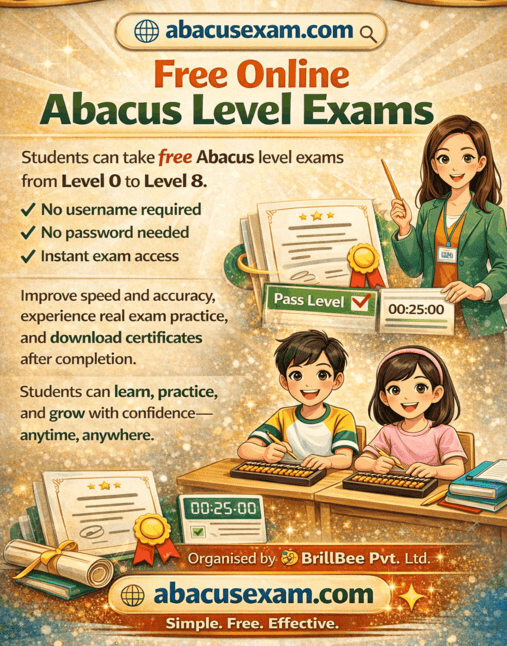
- 📊 Track progress with online exams.
- 🧘 Combine with meditation for focus.
- 🏅 Celebrate every milestone.
✅ Do’s & ❌ Don’ts for 2025 Learners
✅ Do’s
- Use structured curriculum
- Practice daily 15 min
- Take mock tests
- Watch YouTube tutorials
❌ Don’ts
- Don’t rely only on apps
- Avoid long gaps
- Don’t skip finger technique
- No negative reinforcement
📈 What Results to Expect in 2025
- After 3 months: mental addition of 2-digit numbers.
- After 6 months: improved school grades in math.
- After 1 year: confidence to participate in mental math competitions.
See our competition preparation guide and parent testimonials.
❓ FAQs About Abacus in 2025
Q1: Is abacus still relevant in the AI era?
A: Yes, because it develops human cognition, not just calculation.
Q2: Can my child learn abacus online in 2025?
A: Absolutely, live classes and practice platforms are better than ever.
Q3: How much time per day?
A: 15–20 minutes is sufficient for steady progress.
Q4: Will it help with school exams?
A: Most parents report improved speed and fewer errors.
Q5: What age is best?
A: 5–12 years old, but teens also benefit.
📝 Summary: Future-Ready with Abacus
2025 demands sharp thinkers, not just device users. Abacus maths equips your child with mental speed, focus, and confidence — skills that no machine can replace. Start this year and give them a lifelong advantage.