🎓 What Are the Long-Term Academic Benefits of Early Abacus Education?
Quickly jump to any section 👇
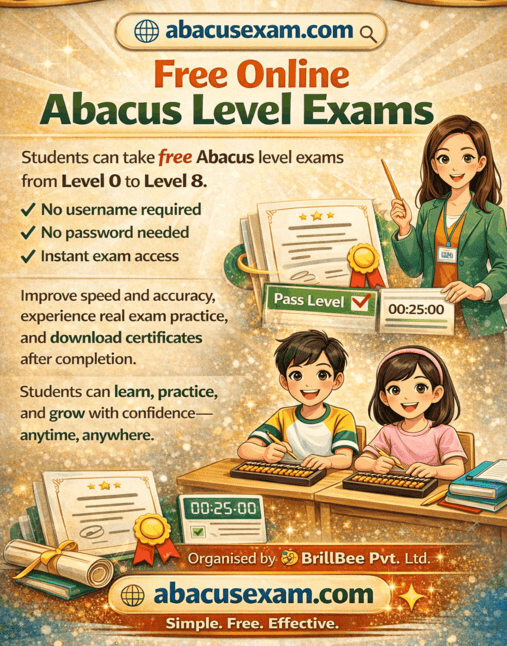
Students who want to improve their calculation speed and accuracy can also do regular practice. You can try abacus practice, abacus exams, and 1-minute mental math challenges here: Practice on Brillbee Academy
🌟 Introduction: Investing in Your Child’s Academic Future
As a parent, you want every advantage for your child’s education. You’ve heard abacus helps with math. But you’re asking the bigger question: “What are the long-term academic benefits of early abacus education?”
This isn’t just about faster calculations today. It’s about building cognitive foundations that support learning for years to come. The research is clear: children who start abacus between ages 4–8 show measurable academic advantages that extend well into secondary school and beyond. In this guide, we’ll explore the science, real student outcomes, and practical insights to help you make an informed decision about your child’s learning journey.
🤔 Why Parents Wonder About Long-Term Value
Many parents hesitate because they see abacus as a “short-term skill.” Common concerns include:
- “Will this help my child in high school math or just elementary arithmetic?”
- “Is abacus worth the time investment compared to other enrichment activities?”
- “Do the benefits last, or do children ‘outgrow’ abacus skills?”
These questions matter. Without evidence of lasting impact, investing in any educational program feels uncertain. Let’s replace speculation with research-backed clarity.
🧠 How Early Abacus Creates Lasting Academic Advantages
Abacus education works differently than rote math practice. It builds cognitive infrastructure that supports learning across subjects and years:
Abacus activates both hemispheres — logical left brain + visual-spatial right brain. This balanced activation strengthens neural pathways used in complex problem-solving throughout academic life.
Visualization, working memory, and pattern recognition trained through abacus apply to science, reading comprehension, coding, and even language learning.
Early success with abacus builds a “I can learn hard things” mindset that reduces anxiety and encourages risk-taking in future academic challenges.
Mental math agility frees up mental energy for higher-order thinking — critical as academic content becomes more complex in later grades.
Research from Stanford University and the University of Tokyo shows that children with 2+ years of early abacus training demonstrate stronger academic performance in math, science, and logical reasoning even 5–7 years later.
📋 How Early Abacus Benefits Unfold Over Time
Long-term academic advantages develop through predictable stages:
This progression shows why starting early matters: each stage builds on the last, creating compound academic advantages.
👦 Real Students, Long-Term Success Stories
Example 1: Priya, Started Age 5 (India)
Completed abacus training by age 9. By Grade 10, she consistently ranked top 5% in math and science. Now pursuing engineering at a top university. Her teachers credit early abacus for her “exceptional problem decomposition skills.”
Example 2: Liam, Started Age 6 (Canada)
Struggled with focus in early grades. After 3 years of abacus, his concentration improved dramatically. By middle school, he excelled in math olympiads and coding clubs. His parents note: “Abacus didn’t just teach math — it taught him how to learn.”
Example 3: Zara, Started Age 4 (UK)
Used abacus to overcome early math anxiety. By secondary school, she chose advanced math tracks and now mentors younger students. Her testimonial: “Abacus gave me confidence that carried through every subject.”
These aren’t outliers. They’re replicable outcomes when abacus training starts early and continues consistently.
✨ The Multi-Year Academic Advantage of Early Abacus
Research and classroom experience confirm these lasting benefits:
- 📈 Stronger Math Trajectory: Early number sense predicts later algebra success; abacus builds that foundation deeply
- 🔬 STEM Readiness: Visualization and logical thinking support science, coding, and engineering concepts
- 📖 Cross-Subject Transfer: Working memory and focus improvements benefit reading comprehension and language learning
- 🎯 Exam Performance: Mental agility and error-checking skills provide advantages in timed assessments throughout schooling
- 🧠 Cognitive Resilience: Children develop “learning how to learn” skills that adapt to new academic challenges
- 💡 Creative Problem-Solving: Right-brain activation fosters innovative approaches to complex academic tasks
Early abacus isn’t a shortcut — it’s an investment in your child’s cognitive toolkit for life.
🔍 Deep Dive: The Science Behind Long-Term Benefits
Why do early abacus benefits last? Three research-backed mechanisms:
1. Myelination of Neural Pathways
Repeated abacus practice strengthens connections between brain regions. This “wiring” becomes more efficient over time, supporting faster information processing in academic tasks years later.
2. Executive Function Development
Abacus training enhances working memory, cognitive flexibility, and inhibitory control — core executive functions that predict academic success across all subjects and grade levels.
3. Growth Mindset Formation
Early mastery experiences with abacus build confidence in learning ability. Children who believe “I can improve with effort” persist longer through academic challenges throughout their education.
Key Takeaway The benefits aren’t just “math skills” — they’re foundational cognitive capacities that support learning in every academic domain.
⭐ Expert Tips by Ashwani Sharma
Having guided thousands of young learners, here are my top tips for maximizing long-term academic benefits:
- 🎯 Start early, stay consistent: Ages 4–8 are ideal for foundational brain development; even 15 minutes daily creates lasting impact
- 🔄 Connect to school learning: Help your child see how abacus skills apply to current math topics — this reinforces transfer
- 📊 Track progress holistically: Note improvements in focus, confidence, and problem-solving — not just calculation speed
- 🤝 Partner with teachers: Share your child’s abacus journey with school educators to align support strategies
- 🎉 Celebrate effort over outcomes: Praise persistence and strategy use — this builds the growth mindset that fuels long-term success
- 🌍 Think beyond math: Encourage your child to apply visualization and focus skills to reading, science, and creative projects
- ⏳ Be patient with the process: Long-term benefits compound over years — trust the journey even when immediate results seem small
✅ Do’s and ❌ Don’ts for Long-Term Abacus Success
- Start abacus training between ages 4–8 for maximum neuroplasticity benefits
- Maintain consistent practice even after mastering basics
- Connect abacus skills to school subjects to reinforce transfer
- Celebrate cognitive growth (focus, confidence) alongside academic results
- Revisit abacus concepts during challenging academic periods for reinforcement
- Stop practice abruptly after “completing” a level — maintenance matters
- Focus only on speed; accuracy and understanding create deeper learning
- Compare your child’s progress with peers; long-term growth is personal
- Ignore signs of burnout; short, joyful sessions sustain motivation
- Assume benefits are automatic; intentional connection to academics maximizes impact
📈 What Long-Term Results Can You Expect?
❌ Common Mistakes That Limit Long-Term Benefits
While older children benefit, ages 4–8 offer peak neuroplasticity for foundational cognitive development.
Neural pathways strengthen through repetition. Irregular practice slows long-term consolidation.
Without intentional connection to school learning, transfer of skills diminishes over time.
Pressure to win can reduce joy and intrinsic motivation — key drivers of sustained engagement.
Cognitive benefits compound with continued practice. Maintenance sessions preserve advantages.
Focusing only on calculation speed misses the broader cognitive and confidence benefits that drive long-term success.
• Best Age to Start Abacus: Complete Parent’s Guide
• How Abacus Boosts Brain Development: Science Explained
• Preparing Your Child for STEM Success with Abacus
❓ Frequently Asked Questions
🎯 Summary: The Lifelong Academic Investment
So, what are the long-term academic benefits of early abacus education?
Research confirms lasting advantages:
✅ Cognitive Foundation: Enhanced working memory, visualization, and bilateral brain development support learning across all subjects
✅ Math Trajectory: Strong number sense predicts success in algebra, calculus, and advanced STEM coursework
✅ Academic Confidence: Early mastery experiences build a growth mindset that fuels persistence through future challenges
✅ Transferable Skills: Focus, pattern recognition, and problem-solving agility benefit reading, science, coding, and beyond
✅ Lifelong Learning: Cognitive efficiency and adaptability support continuous education and career growth
Early abacus education isn’t just about beads and numbers. It’s about building the brain that learns — confidently, creatively, and competently — for life.
Start early. Practice consistently. Connect to academics. Watch your child’s potential unfold.
Start Abacus Training Today
📞 Call/WhatsApp: +91 96641 11853
✨ Age-appropriate curriculum • Certified trainers • Focus on lifelong cognitive development
© 2026 abacusexam.com | Empowering Young Minds Through Abacus Education
🌍 Serving Students in India, USA, UK, Canada, Australia, UAE & Worldwide