What Age Group Benefits Most from After-School Abacus Programs?
As a parent, you may wonder — “Is my child too young or too old for abacus learning?”
This is one of the most common questions parents ask before enrolling their child in after-school abacus programs. And the answer can directly impact your child’s learning success.
Let’s explore the ideal age group for abacus training and why timing matters so much.
Quickly jump to any section 👇
Problem Understanding
Many parents either start too early or delay abacus learning. Some believe younger children cannot understand it, while others think older children will learn faster.
Both assumptions can lead to missed opportunities.
Main Concept
Abacus learning is most effective when the brain is in its development stage. This is when children can absorb new skills quickly and build strong mental connections.
The ideal age group for after-school abacus programs is:
- 4 to 14 years — Maximum learning potential
However, the best results are seen between 5 to 10 years.
Step-by-Step Age Breakdown
Age 4–6 Years
This is the foundation stage. Children develop basic number sense and finger movement skills.
Age 7–10 Years
This is the golden learning period. Brain development is at its peak, making it the best time for abacus training.
Age 11–14 Years
Children can still learn effectively, but progress may be slightly slower compared to younger kids.
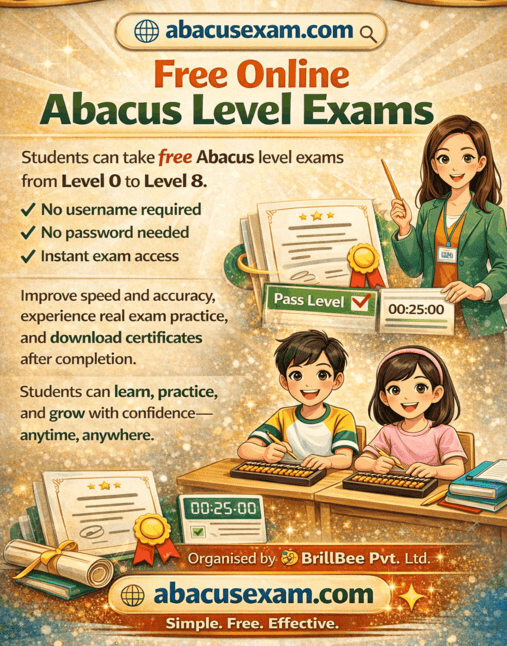
Students who want to improve their calculation speed and accuracy can also do regular practice. You can try abacus practice, abacus exams, and 1-minute mental math challenges here: Practice on Brillbee Academy
Examples
👦 A 6-year-old child learns abacus → Develops strong mental math skills quickly
👧 A 12-year-old child starts abacus → Learns well but takes more time to master visualization
This shows how early learning gives an advantage.
Benefits of Learning at the Right Age
- Faster brain development
- Improved memory power
- Better concentration
- Stronger calculation skills
- Higher confidence in academics
Detailed Explanation
Let’s understand why age matters so much in abacus learning:
1. Brain Plasticity
Young children have flexible brains that adapt quickly to new skills like mental calculation.
2. Visualization Ability
Abacus requires imagination. Younger children develop visualization skills faster.
3. Habit Formation
Early learning helps build discipline and study habits.
Explore our abacus learning courses to understand structured programs.
You can also read about how to choose the right abacus instructor for better results.
⭐ Expert Tips by Ashwani Sharma
- Start abacus between age 5–8 for best results
- Ensure regular practice at home
- Choose interactive classes
- Keep sessions fun and engaging
- Track progress monthly
- Avoid putting pressure on children
✅ Do’s and ❌ Don’ts in Abacus Learning
Do’s
- Start at the right age
- Encourage daily practice
- Choose qualified instructors
- Support your child’s learning
- Be patient with progress
Don’ts
- Don’t delay learning too much
- Don’t expect instant results
- Don’t skip practice
- Don’t force the child
- Don’t compare with others
📈 What Results Can You Expect?
- Faster calculations
- Better focus
- Improved memory
- Higher academic performance
- Strong confidence in math
❌ Common Mistakes in Abacus Learning
- Starting too late
- Lack of consistency
- Ignoring practice
- Choosing wrong instructor
- Unrealistic expectations
FAQs
What is the best age to start abacus?
Between 5 to 10 years is ideal.
Can older children learn abacus?
Yes, but learning speed may be slower.
Why is early learning important?
Because brain development is faster in younger children.
Is abacus useful for teenagers?
Yes, it still improves focus and calculation skills.
How long does it take to see results?
Usually 3–6 months with regular practice.
Summary
The best age group for after-school abacus programs is between 5 to 10 years. This is when children gain maximum benefits in brain development and learning speed.
However, it is never too late to start. With the right guidance and practice, every child can benefit from abacus training.
Start Abacus Training Today
📞 Call/WhatsApp: +91 96641 11853
Ashwani Sharma is an Abacus Trainer & Mental Math Educator from Jaipur with 10+ years of experience. He specializes in Abacus Training, Mental Math, Brain Development, and Vedic Maths.
🎥 Learn more on YouTube: English Playlist | Hindi Playlist
📞 Training ke liye WhatsApp/Call: +91 96641 11853