How Does Regular Abacus Practice Improve Visualization Skills?
Have you ever seen a child solving complex math problems without writing anything down? That’s the power of visualization — and abacus training makes it possible.
Visualization is the ability to see numbers and calculations in the mind. And this skill becomes stronger with regular abacus practice.
Let’s understand how this amazing transformation happens.
Quickly jump to any section 👇
Problem Understanding
Many children struggle with math because they cannot “see” numbers clearly in their mind. They depend on paper, fingers, or calculators.
Main Concept
Abacus training converts physical bead movement into mental images. Over time, children start imagining the abacus in their mind.
This mental image helps them perform calculations quickly and accurately.
Step-by-Step Method
1. Physical Abacus Learning
Children learn basic number representation using beads.
2. Finger Movement Practice
They practice moving beads with speed and accuracy.
3. Mental Visualization
They start imagining the abacus in their mind.
4. Advanced Mental Math
They solve problems without any physical tool.
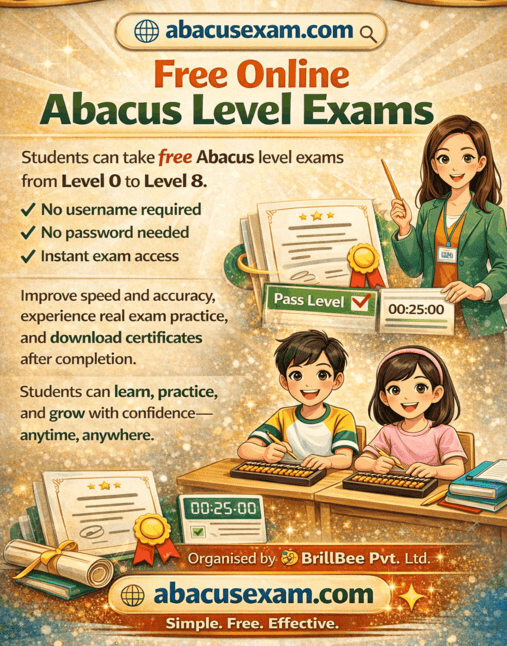
Students who want to improve their calculation speed and accuracy can also do regular practice. Practice on Brillbee Academy
Examples
👦 A child imagines beads moving → solves 3-digit addition instantly
👧 A trained student visualizes numbers → answers faster than writing
Benefits of Visualization Skills
- Faster calculations
- Better memory
- Improved focus
- Strong imagination power
- Higher confidence
Detailed Explanation
Visualization improves brain coordination between left (logic) and right (creativity) brain.
Regular practice strengthens this connection, making learning easier.
Explore our abacus training programs.
⭐ Expert Tips by Ashwani Sharma
- Practice daily for 10–15 minutes
- Focus on accuracy first
- Encourage mental calculation
- Use visualization exercises
- Stay consistent
✅ Do’s and ❌ Don’ts in Abacus Learning
Do’s
- Practice regularly
- Stay patient
- Encourage imagination
- Follow proper steps
- Track progress
Don’ts
- Don’t skip basics
- Don’t rush learning
- Don’t ignore practice
- Don’t depend on calculators
- Don’t lose consistency
📈 What Results Can You Expect?
- Stronger visualization
- Faster mental math
- Better academic performance
- Improved memory
- Higher confidence
❌ Common Mistakes in Abacus Learning
- Irregular practice
- Skipping visualization stage
- Focusing only on speed
- Lack of guidance
- Giving up early
FAQs
What is visualization in abacus?
It means imagining the abacus in the mind.
How long does it take to develop?
Usually 3–6 months with practice.
Is visualization important?
Yes, it is key for mental math.
Can all children develop it?
Yes, with proper training.
Does it improve memory?
Yes, significantly.
Summary
Regular abacus practice builds strong visualization skills that improve speed, memory, and confidence.
Start Abacus Training Today
📞 Call/WhatsApp: +91 96641 11853
Ashwani Sharma – Abacus Trainer & Mental Math Educator with 10+ years experience.
English Playlist
📞 +91 96641 11853