Welcome! I’m Ashwani Sharma, and for many years now I’ve had the privilege of working closely with students, parents, and teachers through my role at Mission Abacus Private Limited in Jaipur, India.
In this blog, I want to walk you gently through how abacus exams improve speed & accuracy, not as a theory, but as something I’ve seen unfold again and again in real learning environments—classrooms, online sessions, and quiet study corners at home.
If you’re a parent wondering whether exams create pressure, a teacher trying to guide beginners, or an adult learner curious about mental math, you’re in the right place. Within the first few months of structured practice, many learners begin to notice that their calculation speed improves and mistakes reduce. That’s the heart of this discussion.
Table of Contents 📘
- Understanding Abacus Exams for Beginners
- Why Speed and Accuracy Matter in Learning
- How Abacus Exams Improve Speed & Accuracy Over Time
- The Role of Structured Levels and Exams
- From Fingers to Visualization: A Natural Progression
- Benefits for Students, Parents, and Teachers
- Real Classroom Observations from Years of Teaching
- Using the All-in-One Abacus Learning System
- Time Management and Exam Readiness
- When Abacus May Not Be Enough
- Practical Tips for Better Exam Results
- A Gentle Note for Aspiring Teachers
- Frequently Asked Questions
Understanding Abacus Exams for Beginners 🧠

Abacus exams are not about ranking children or creating stress.
At their core, they are milestones.
Each exam checks whether a learner can handle numbers smoothly, remember steps, and stay focused for a fixed time. For beginners, this structure brings clarity. They know what to practice and why they are practicing it.
Over the years, I’ve noticed that students who prepare for exams take practice more seriously—but in a healthy way. The exam gives direction, not fear.
Why Speed and Accuracy Matter in Learning ✍️
Speed without accuracy creates careless habits.
Accuracy without speed creates hesitation.
In maths—and in life—we need both.
When learners work with abacus regularly, they begin to calculate faster without rushing. Their minds stay calm, and hands move with purpose. This balance is exactly why educators across countries—from India to the UK, from Canada to Australia—continue to value abacus-based assessments.

How Abacus Exams Improve Speed & Accuracy Over Time 🚀
H3: The rhythm of regular testing
The real magic of how abacus exams improve speed & accuracy lies in repetition with reflection.
Each exam:
- Encourages timed practice
- Highlights weak areas
- Builds familiarity with numbers
Over time, students stop counting. They start knowing.
H4: Small steps, lasting confidence
At the early levels, progress may feel slow.
But something important is happening underneath—neural connections are forming.
This gradual strengthening is what leads to long-term speed and dependable accuracy.
The Role of Structured Levels and Exams 📊
Abacus exams are usually divided into levels.
Each level adds complexity, not pressure.
This structure:
- Prevents overload
- Builds confidence step by step
- Helps teachers guide students clearly
Parents often tell me that their child becomes more organized in other subjects too. That’s not coincidence—it’s the result of structured thinking.
From Fingers to Visualization: A Natural Progression 💡
In the beginning, students rely on physical movement.
Later, they imagine the abacus.
This mental visualization is crucial.
Based on real classroom learning, I’ve seen that exams gently push students toward mental calculation because speed demands efficiency. Visualization becomes a friend, not a forced skill.
Benefits for Students, Parents, and Teachers 🌍
For Students
- Faster calculations
- Fewer careless mistakes
- Improved focus
For Parents
- Clear progress tracking
- Reduced homework stress
- Better confidence in maths
For Teachers
- Measurable outcomes
- Structured lesson planning
- Clear student feedback
And let’s remember this truth once, clearly and honestly:
Students who practice regularly, appear for level exams, and participate in competitions show faster improvement in speed, accuracy, and confidence.
Real Classroom Observations from Years of Teaching 🎓
In my experience working with students and teachers, I’ve noticed something simple but powerful:
students who respect the exam process respect their own learning.
They don’t panic.
They prepare steadily.
Over the years, I’ve also seen hesitant learners transform—not because they became “math geniuses,” but because they trusted the process.
Let me ask you something to reflect on:
Is your child struggling with maths because of ability—or because of confidence?
Often, it’s the latter.

Using the All-in-One Abacus Learning System 🧮
Many learners today combine offline practice with digital support. Platforms like:
- 🏅 Abacus competitions via https://abacusshiksha.com
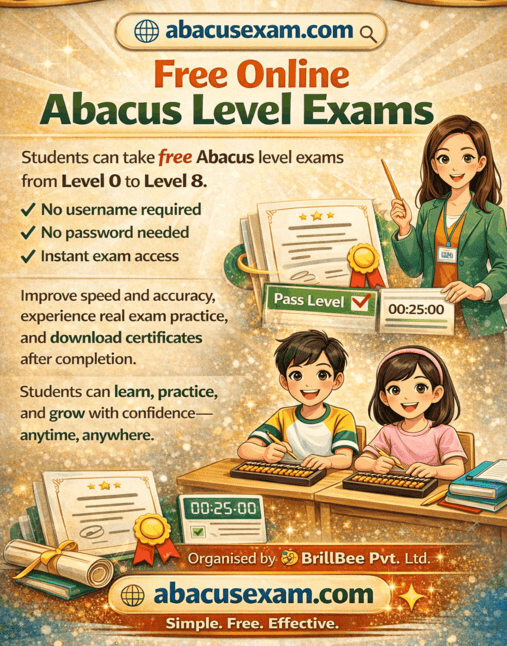
- 📝 Level-based exams through https://abacusexam.com
- 🎧 Audio practice and long challenges at https://abacuswala.com
Together, they form an All-in-One Abacus Learning System that supports consistent practice without overwhelming the learner.
Time Management and Exam Readiness ⏱️
One common concern is timing.
Exams teach learners how to:
- Allocate time wisely
- Avoid getting stuck on one question
- Maintain calm under limits
For practical guidance, this resource on managing time effectively during abacus exams is very helpful:
https://abacusexam.com/abacus-exam-duration-time-management-tips/
These small skills transfer beautifully into school exams and even adult work habits.
When Abacus May Not Be Enough ⚖️
Let’s be honest and balanced.
Abacus exams improve speed and accuracy—but they are not a replacement for:
- Conceptual maths understanding
- Logical reasoning practice
- School curriculum alignment
If a learner memorizes without understanding, progress will stall. Abacus works best when combined with regular school maths and supportive teaching.
Practical Tips for Better Exam Results 📘
Practice daily, even if briefly.
Encourage calm, not comparison.
Treat exams as feedback, not judgment.
Consistency always beats intensity.
A Gentle Note for Aspiring Teachers 🌱
If you’re considering guiding others, learning how exams are structured gives clarity and confidence. Many educators explore free abacus teacher training opportunities simply to understand the learning process better—not to change careers overnight.
Mission Abacus Private Limited supports this learning-first mindset, and that approach matters.
Frequently Asked Questions ❓
Can abacus exams really improve calculation speed?
Yes, with regular practice.
Speed increases gradually, not instantly.
Accuracy improves alongside confidence.
Is it worth giving exams at an early age?
Yes, if the approach is gentle.
Exams should motivate, not pressure.
Early exposure builds familiarity.
How long does it take to see improvement?
Usually a few months.
Progress depends on consistency.
Every learner grows at their own pace.
Do abacus exams help adults too?
Absolutely.
Adults gain focus and mental agility.
Age is not a barrier.
Are online abacus exams effective?
They can be.
Proper guidance is key.
Discipline matters more than format.
A Final Personal Note ✍️🌍
As someone who has walked this path with thousands of learners, I can say this with calm confidence: abacus exams are not about proving intelligence. They are about building trust in one’s own ability.
If approached with patience and honesty, they quietly sharpen speed, steady accuracy, and nurture confidence—skills that last far beyond the exam paper.
Warm regards,
Ashwani Sharma
Director, Mission Abacus Private Limited