Does Abacus Help Children with Dyscalculia or Maths Anxiety?
Honest review with real parent stories and expert insights from 10+ years of abacus training in Jaipur
Quickly jump to any section 👇
Introduction
Many bright children suddenly go blank when they see numbers. They feel scared of math class, avoid homework, or cry before tests. This is often due to dyscalculia (difficulty understanding numbers) or maths anxiety (fear of mathematics).
Parents frequently ask me: “Does abacus help children with dyscalculia or maths anxiety?”
After training hundreds of children in Jaipur for over 10 years, I can confidently say — yes, abacus training helps many children overcome these challenges. It turns fear into confidence through a fun, hands-on method.
Problem Understanding
Dyscalculia makes it hard for children to understand quantities, remember math facts, or grasp concepts like place value. Maths anxiety causes panic, avoidance, and low self-esteem even when the child is intelligent in other areas.
Traditional teaching methods often make the problem worse because they rely heavily on rote memorization and written work, which increases pressure instead of building understanding.
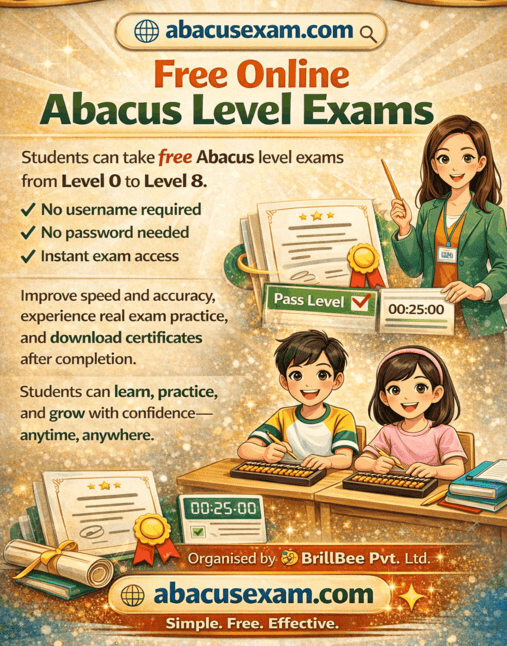
Students who want to improve their calculation speed and accuracy can also do regular practice.
You can try abacus practice, abacus exams, and 1-minute mental math challenges here:
Practice on Brillbee Academy
Main Concept
Abacus uses beads to represent numbers physically. Children move beads with their fingers while learning place value visually. This concrete-to-abstract method helps the brain form strong number connections. Over time, children visualize the abacus mentally, turning scary numbers into a clear mental image they can control.
Step-by-Step Method
Abacus training for children with dyscalculia or maths anxiety follows a gentle, confidence-building path:
- Introduction to Beads: Fun games with the abacus to remove fear of numbers.
- Basic Concepts: Understanding place value and simple addition/subtraction using physical movement.
- Visualization: Learning to “see” calculations in the mind without fear.
- Small Wins: Mastering easy problems first to build confidence.
- Integration: Applying skills to school math in a stress-free way.
Real Examples & Success Stories
A 8-year-old girl in Jaipur had severe maths anxiety — she would freeze during tests. After 7 months of abacus, she started enjoying numbers and scored 85% in her math exam for the first time.
Another boy diagnosed with dyscalculia struggled with basic addition. With patient abacus training, he could now add and subtract 3-digit numbers mentally and felt proud instead of scared.
Parents often tell me their child now volunteers to solve math problems at home — a huge shift from complete avoidance.
Benefits for Dyscalculia & Maths Anxiety
- Builds strong number sense through visual and tactile learning
- Reduces fear by making math concrete and fun
- Improves calculation accuracy and speed gradually
- Boosts self-confidence with every small success
- Strengthens working memory and logical thinking
- Helps children enjoy mathematics instead of fearing it
Detailed Explanation
Dyscalculia affects how the brain processes numerical information. Abacus bypasses weak areas by using multiple senses — sight (seeing beads), touch (moving beads), and hearing (saying numbers). This multi-sensory approach creates new neural pathways.
For maths anxiety, the biggest relief comes from removing the “paper-and-pencil pressure.” Children work with a tool that feels like a toy, so anxiety drops naturally. Consistent practice rewires the brain from “math is scary” to “I can do this.”
In my experience, children with these challenges show the most emotional improvement — tears turn into smiles when they succeed with abacus.
⭐ Expert Tips by Ashwani Sharma
- Start with very short, fun sessions to avoid overwhelm.
- Focus on understanding concepts rather than speed in the beginning.
- Celebrate every small achievement to rebuild confidence.
- Choose a trainer experienced with learning difficulties.
- Practice in a calm, pressure-free environment at home.
- Combine abacus with real-life math like shopping or cooking.
- Be patient — progress may be slower but is very rewarding.
✅ Do’s and ❌ Don’ts for Dyscalculia & Maths Anxiety
✅ Do’s
- Make practice sessions short and enjoyable
- Praise effort more than correct answers
- Use positive language around math
- Work at the child’s own pace
- Link abacus to daily life activities
❌ Don’ts
- Don’t rush or force speed
- Don’t compare with siblings or classmates
- Don’t scold for mistakes
- Don’t expect quick fixes
- Don’t give up after a few weeks
📈 Expected Results
- Reduced fear and avoidance of mathematics
- Better understanding of basic number concepts
- Improved accuracy in simple calculations
- Increased confidence during school tests
- Positive attitude towards math
- Stronger foundation for higher classes
❌ Common Mistakes
- Starting with too much pressure for speed
- Choosing large batch classes without individual attention
- Stopping training when initial progress feels slow
- Focusing only on drills instead of fun learning
- Not coordinating with school teachers
- Expecting abacus to replace all other support
FAQs
Q1. Can abacus cure dyscalculia?
Abacus cannot cure dyscalculia, but it can significantly improve number skills and reduce its impact.
Q2. Is abacus suitable for children with severe maths anxiety?
Yes. Its playful, hands-on nature helps reduce anxiety better than traditional methods.
Q3. How long does it take to see improvement?
Many children show reduced anxiety and better understanding within 4–8 months.
Q4. Should we continue school math tuition along with abacus?
Yes. Abacus works best as a supportive tool alongside regular studies.
Q5. What age is best to start for dyscalculia?
Ideally between 6 to 11 years, but benefits can appear at any age with proper guidance.
Summary
Abacus training is one of the most effective tools to help children struggling with dyscalculia or maths anxiety. By making numbers visible and touchable, it rebuilds confidence and understanding step by step. Many children who once feared math start enjoying it after consistent abacus practice.
If your child faces these challenges, abacus can be a game-changer when introduced with patience and the right support.
🚀 Help Your Child Overcome Maths Fear!
Start Abacus Training Today
📞 Call / WhatsApp: +91 96641 11853
Ashwani Sharma – Abacus & Mental Math Trainer, Jaipur
Ashwani Sharma is an Abacus Trainer & Mental Math Educator based in Jaipur with over 10 years of experience. He specializes in Abacus Training, Mental Math, Brain Development, and Vedic Maths.
Watch free lessons:
English YouTube Playlist | Hindi YouTube Playlist
Training ke liye WhatsApp/Call: +91 96641 11853