Mental Math Abacus Curriculum Aligned with International Standards
🌍 Introduction: What Makes a Curriculum “International”?
Parents often ask: “Is there a global standard for abacus and mental math?” The answer is yes. Reputable international bodies like the International Abacus Association, Japanese Abacus Committee, and various exam boards have defined clear level-wise syllabi. An internationally aligned abacus curriculum ensures that a student in India, USA, or UK learns the same core skills — from basic bead movement to complex mental visualization. In this guide, I’ll walk you through the complete framework, so you can confidently choose or evaluate an abacus program.
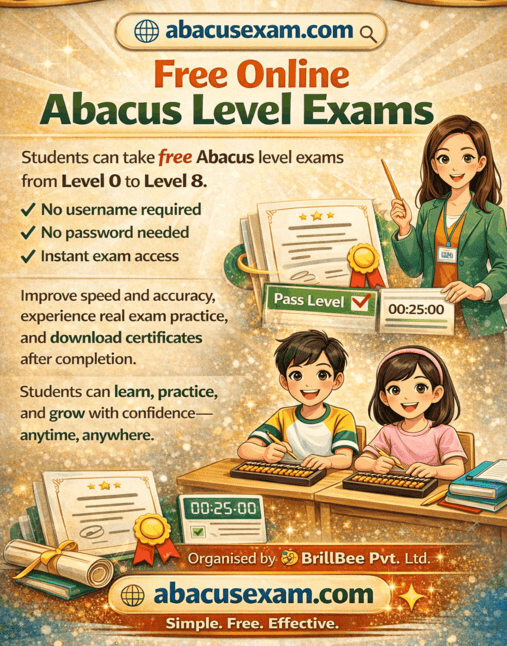
Students who want to improve their calculation speed and accuracy can also do regular practice. You can try abacus practice, abacus exams, and 1-minute mental math challenges here: Practice on Brillbee Academy
📚 Problem: Why a Standardized Curriculum Matters
Without a global framework, students may learn random techniques that don’t build progressive skills. They might miss foundational concepts like complementary numbers, small friend/big friend formulas, or proper finger techniques. A standardized curriculum gives clear milestones: from basic addition (Level 1) to multiplication/division (Level 4) and advanced decimal/negative numbers (Level 8). It also prepares students for international competitions and certifications.
🧮 Core Components of International Abacus Curriculum
Every authentic abacus program includes: 1) Physical abacus manipulation (tool-based), 2) Mental visualization (image abacus), 3) Speed-building drills, 4) Dictation exercises, and 5) Periodic assessments. The curriculum is typically divided into 8–10 levels, each taking 3–4 months. International standards emphasize accuracy first, then speed, and finally mental-only calculations without touching the abacus.
📊 Step-by-Step Level Breakdown (International Standard)
Level 1 (Foundation): Introduction to abacus parts, bead values, basic addition/subtraction (single digit, no formulas). Level 2: Small friend (+1 to +4) and big friend (+5 to +9) formulas. Level 3: Mixed formulas, double-digit direct sums. Level 4: Multiplication (2×1 digit) and division introduction. Level 5: Mental abacus (no physical tool) for 2-digit numbers. Level 6–8: Decimals, fractions, negative numbers, 3-digit mental math, and competition-level speed (100 sums in 5 minutes).
📌 Real-World Example: Aarav’s Journey Through Levels
Aarav (age 8) started Level 1 with zero knowledge. After 3 months, he could do 30 single-digit sums in 2 minutes. By Level 4 (12 months), he mastered multiplication tables and 2×2 digit multiplication mentally. His school math scores jumped from B+ to A+. Because his curriculum was aligned with international standards, he later represented his state in an online global abacus competition.
✅ Benefits of Following Global Standards
- 🎯 Recognized certificates for higher education or skill portfolios.
- 🧠 Systematic brain development – left & right hemisphere coordination.
- ⚡ Smooth transition to Vedic maths or advanced mental arithmetic.
- 🏆 Eligibility for international olympiads (e.g., International Abacus Olympiad).
- 📈 Clear progress tracking for parents and teachers.
🔬 Detailed Syllabus Explanation: What Each Level Teaches
Let me elaborate Level 3 as an example: Students learn combination formulas like +6 = +10 – 4 (big friend) and +1 = –4 +5 (small friend) simultaneously. They practice 40-row sums with 2-digit numbers. Speed target: 40 sums in 6 minutes with 95% accuracy. This structured difficulty increase is what makes international curricula effective. Similarly, Level 6 introduces mental division using the abacus image in the brain — a proven technique used in Japan for over 50 years.
⭐ Expert Tips by Ashwani Sharma
- 📌 Always ask for the curriculum map before enrolling.
- 📌 Ensure your child practices at least 15 minutes daily – consistency beats intensity.
- 📌 Use international workbooks (e.g., from Japan Abacus Association).
- 📌 Take mock tests under timed conditions every month.
- 📌 Don’t skip mental visualization practice – it’s the core of advanced levels.
- 📌 Celebrate level completion with a small reward – builds momentum.
✅ Do’s and ❌ Don’ts in Abacus Learning
Do’s: Do follow level order strictly. Do use correct finger techniques (thumb for lower beads, index for upper). Do track speed weekly. Do enroll for certification exams. Do encourage group practice for fun.
Don’ts: Don’t rush levels – mastery is key. Don’t compare siblings’ progress. Don’t use calculators during practice. Don’t ignore dictation (listening sums). Don’t change abacus brands frequently – muscle memory matters.
📈 Expected Results from an International Curriculum
- ✨ Within 6 months: 2x faster than school math calculations.
- ✨ Within 12 months: Mental addition/subtraction of 3-digit numbers.
- ✨ Within 18 months: Multiplication of 2×2 digit mentally under 10 seconds.
- ✨ Improved concentration, memory, and self-confidence.
- ✨ Ability to crack abacus exams up to Level 6 with distinction.
❌ Common Mistakes in Abacus Learning
- 1. Starting with a non-standardized workbook – leads to gaps.
- 2. Skipping physical abacus practice too early.
- 3. Only practicing addition, ignoring subtraction and division.
- 4. Not maintaining a speed log – no visible progress.
- 5. Using wrong hand posture – reduces speed potential.
- 6. Joining a class that doesn’t offer international exam preparation.
For more details, explore our complete abacus certification levels guide and scientific benefits of mental math training.
❓ FAQs on International Abacus Curriculum
Q1: What is the most recognized international abacus certification?
A: Japanese Soroban and Chinese Zhusuan certifications are globally respected.
Q2: At what age can a child start this curriculum?
A: Ideal age is 5–12 years, but even teens can benefit.
Q3: How long does it take to complete all levels?
A: Typically 2–3 years with regular practice (2–3 sessions/week).
Q4: Is online abacus training as effective as offline?
A: Yes, if the curriculum is structured and includes live instructor feedback.
Q5: Does this curriculum help with competitive exams like SAT or Olympiads?
A: Absolutely – mental math speed gives a huge edge in math sections.
Q6: Are there any official textbooks?
A: Yes, we recommend IAHP or JISA-approved workbooks.
🚀 Give Your Child a Smart Start!
Start Abacus Training Today – internationally aligned curriculum.
📞 Call/WhatsApp: +91 96641 11853📌 Summary: Why International Standards Matter
A well-structured, globally aligned abacus curriculum ensures your child learns the right skills in the right order. It provides measurable milestones, recognized certifications, and a clear path to mental math mastery. By choosing a program that follows international standards, you’re giving your child a competitive edge that lasts a lifetime.