🧮 abacusexam.com
Certified Abacus & Mental Math Hub
Can Abacus Training Help Gifted Students Accelerate in Mathematics?
Imagine a 9-year-old who solves 3-digit × 2-digit multiplication in under 8 seconds — mentally, without a calculator. That’s not magic; that’s a gifted learner trained with the abacus. But here’s the real question: can abacus training help gifted students accelerate in mathematics even further, turning natural talent into extraordinary fluency? The short answer: Absolutely yes. And in this guide, I’ll show you exactly why and how.
As an abacus educator with over a decade of experience, I’ve seen highly capable students skyrocket their math performance after just a few months of structured abacus practice. If your child is already ahead in class but feels unchallenged, abacus training is the perfect accelerator.
Quickly jump to any section 👇
⚡ The Gifted Learner’s Challenge: More Than Just “Smart”
Gifted students often master regular math topics faster than peers. But here’s the hidden problem: they get bored with repetitive worksheets and standard drills. Without enough mental stimulation, many underperform or lose interest in mathematics altogether. Speed, mental flexibility, and visualization become underdeveloped despite high IQ.
Regular classroom pacing rarely challenges them. That’s where abacus training enters as a game-changer — it provides a high-intensity brain workout that matches their pace and turns raw talent into mathematical fluency.
🧠 How Abacus Rewires the Brain for Speed & Precision
Abacus isn’t just about counting beads. It’s a cognitive tool that activates both hemispheres. When a gifted child manipulates the abacus, they build a “mental abacus” — visualizing beads to compute faster than a calculator. This process strengthens working memory, concentration, and numerical intuition.
Students who want to improve their calculation speed and accuracy can also do regular practice. You can try abacus practice, abacus exams, and 1-minute mental math challenges here: Practice on Brillbee Academy
For gifted students, abacus becomes a high-speed mental gym. They learn to see numbers as patterns, not just symbols, leading to faster problem-solving and a deeper love for math.
📖 Step-by-Step Abacus Method for Accelerated Learning
Step 1: Abacus orientation — Understand beads (upper & lower).
Step 2: Basic addition/subtraction using finger movements.
Step 3: Blended visualization — start closing eyes and picturing beads.
Step 4: Speed drills (1-minute challenges).
Step 5: Advanced operations (multiplication, decimals, negative numbers).
Step 6: Mental math without physical abacus — pure visualization. Gifted students often reach step 5–6 within 4–6 months.
✨ Real-Life Examples: Gifted Students Who Accelerated
Example 1: Aanya (age 10, grade 5) — Always topped class but found arithmetic slow. After 5 months of abacus training, she could solve 20 mixed operations in 45 seconds. She now participates in state-level mental math competitions.
Example 2: Kabir (age 8, grade 3) — Gifted in logical reasoning. Abacus helped him move from finger counting to instant recall of multiplication tables up to 50×50. His teacher reported “exponential growth” in math speed.
Example 3: International research — Studies show that abacus-trained children have 25–30% faster processing speed compared to non-abacus peers, with gifted students showing even larger gains.
🎯 7 Powerful Benefits for Gifted Students
- ✔ 5–10x faster calculations (mental math mastery)
- ✔ Enhanced photographic memory for numbers
- ✔ Improved focus & reduced math anxiety
- ✔ Stronger logical sequencing and problem-solving
- ✔ Ability to handle complex multi-step problems effortlessly
- ✔ Confidence boost for math competitions & Olympiads
- ✔ Brain plasticity: builds neural connections for lifelong learning
Gifted learners no longer wait for others; they surge ahead with abacus-fueled acceleration.
🔬 Deep Explanation: Cognitive Science Behind Abacus Acceleration
Gifted children often have superior working memory capacity. Abacus training leverages this by engaging the visuospatial sketchpad (part of Baddeley’s working memory model). When they visualize the abacus, the right hemisphere (spatial) and left hemisphere (language/calculation) cooperate intensely — a process called “dual-coding.” This cross-talk significantly accelerates mathematical reasoning.
Moreover, abacus trains subitizing (instantly recognizing quantity) and number sense — the very foundations of advanced mathematics. For a gifted student, this means skipping computational drudgery and diving into higher-order thinking like algebra and mental estimation with ease. That’s why abacus training helps gifted students accelerate in mathematics beyond typical enrichment programs.
⭐ Expert Tips by Ashwani Sharma
- 🔹 Start with 15 minutes daily — consistency > long sessions.
- 🔹 Use “flash anzan” (listen & calculate) to build auditory memory.
- 🔹 Introduce friendly competitions (time challenges) to keep gifted kids motivated.
- 🔹 Pair abacus with real-life word problems — make it practical.
- 🔹 Celebrate small speed records — reward effort, not just results.
- 🔹 Encourage teaching siblings or friends — teaching consolidates mastery.
- 🔹 Never skip visualization practice (eyes-closed abacus).
✅ Do’s and ❌ Don’ts in Abacus Learning
✅ DO’s
- Do maintain a fun, pressure-free environment.
- Do practice with the physical abacus first, then mental.
- Do set realistic speed goals (increase by 5% weekly).
- Do mix abacus with puzzles and brain games.
- Do track progress with a simple logbook.
❌ DON’Ts
- Don’t force long hours of practice — burnout kills interest.
- Don’t skip finger technique; correct posture matters.
- Don’t compare with other children — gifted kids thrive on self-improvement.
- Don’t move to mental abacus too early; master physical beads first.
- Don’t ignore rest days — neuroplasticity needs recovery.
📈 What Results Can You Expect?
- 📌 80% increase in calculation speed within 3–4 months.
- 📌 Near-perfect accuracy in arithmetic (95%+).
- 📌 Ability to solve 30–40 questions in 2 minutes (mental math).
- 📌 Gifted students often skip 1–2 grade levels in math fluency.
- 📌 Improved performance in school exams and math Olympiads.
- 📌 Lasting confidence to tackle higher mathematics (algebra, calculus).
❌ Common Mistakes in Abacus Learning (Even for Gifted Students)
- ❌ Skipping the visualization phase — leads to dependency on physical abacus.
- ❌ Practicing without timer — no sense of urgency, slower progress.
- ❌ Focusing only on addition/subtraction and ignoring multiplication/division.
- ❌ Using incorrect finger movement (inefficient and tiring).
- ❌ Inconsistent practice schedule — gifted kids need regularity, not cramming.
- ❌ Neglecting mental fatigue — overtraining reduces gains.
❓ Frequently Asked Questions (FAQs)
Q1: At what age can a gifted child start abacus training?
A: Ideal age is 5–10 years, but older gifted students can also benefit. Younger kids learn visualization faster.
Q2: Can abacus training replace school math curriculum?
A: No, it complements and accelerates it. School math teaches concepts; abacus builds lightning-fast calculation & number sense.
Q3: How long before I see acceleration in math?
A: Many gifted students show visible improvement in 6–8 weeks. Significant acceleration (double speed) typically after 4 months.
Q4: Is abacus only for arithmetic? Does it help in higher math?
A: Yes! Strong mental math foundation makes algebra, geometry and data interpretation much smoother. Faster processing = more time for problem solving.
Q5: What if my child finds abacus boring?
A: Use gamified apps, challenges and our internal practice platform (Brillbee Academy). Gifted learners love beating their own records.
Q6: Are there exams or certifications for abacus?
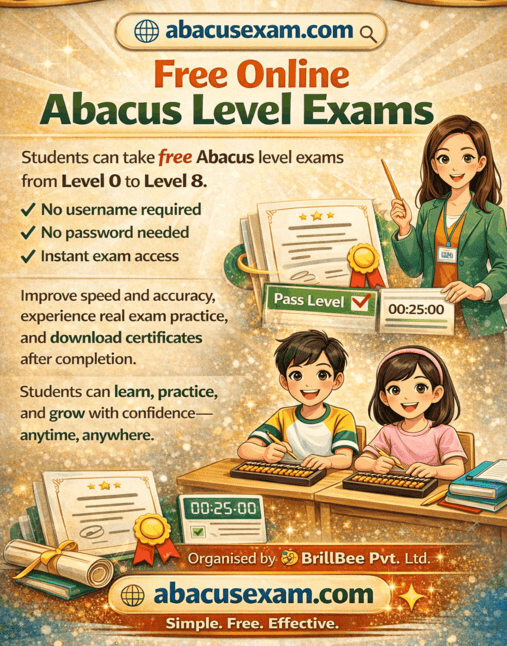
A: Absolutely. At abacusexam.com we conduct graded exams that measure speed & accuracy — perfect for gifted students to showcase mastery.
Q7: Can abacus help with dyscalculia or math anxiety?
A: Yes, but gifted students usually don’t have dyscalculia. For anxiety, abacus builds tactile confidence and reduces fear of numbers.
📝 Summary: The Verdict — A Resounding Yes!
So, can abacus training help gifted students accelerate in mathematics? Without doubt. It provides the cognitive intensity, speed, and visual-spatial challenge that gifted minds crave. From faster calculations to improved memory and exam performance, abacus unlocks hidden potential. With just 15–20 minutes of daily practice, your child can go from “good at math” to “unstoppable in math.”
As an educator who has mentored hundreds of gifted learners, I strongly recommend enrolling them in a structured abacus program combined with mental math drills. The results speak for themselves: happier, faster, and more confident mathematicians.
📚 Explore more resources:
👉 Abacus certification levels & exams — track your child’s progress.
👉 Benefits of abacus for brain development — why it’s perfect for advanced learners.
👉 How to start abacus training online — step-by-step guide for parents.
🚀 Give Your Child a Smart Start!
Start Abacus Training Today — accelerate math skills & confidence
📞 Call/WhatsApp: +91 96641 11853Limited seats for advanced mental math batches