Best Practice Techniques Before Abacus Exams: A Mentor’s Guide
Welcome! I’m Ashwani Sharma. For years, as the Director of Mission Abacus Private Limited in Jaipur, my greatest joy has been watching that “lightbulb moment” when a student truly connects with the abacus. The journey to an exam, however, can feel daunting. Parents often ask me, “How do we prepare properly?” The answer lies not in frantic last-minute drills, but in smart, consistent habits.
In this guide, I’ll share the best practice techniques before abacus exams that I’ve seen make a real difference in classrooms from India to the US. These aren’t theories; they’re methods forged from helping hundreds of students walk into their exam room feeling calm, prepared, and confident. Let’s build a plan that focuses on the learner’s mind as much as their mathematical skill. 🧮
Table of Contents
- Why Exam Preparation is More Than Just Speed
- The 4-Week Pre-Exam Blueprint: A Practical Timeline
- Core Best Practice Techniques Before Abacus Exams
- Technique 1: The Power of Daily Micro-Practice
- Technique 2: Simulating the “Exam Environment”
- Technique 3: Mastering Mental Visualization (The Anzan Shift)
- The Crucial Role of Parents & Teachers
- Building the Right Mindset: Confidence Over Perfection
- A Balanced View: When Abacus May Not Be Enough
- Final Week & Exam Day Checklist
- Frequently Asked Questions (FAQs)

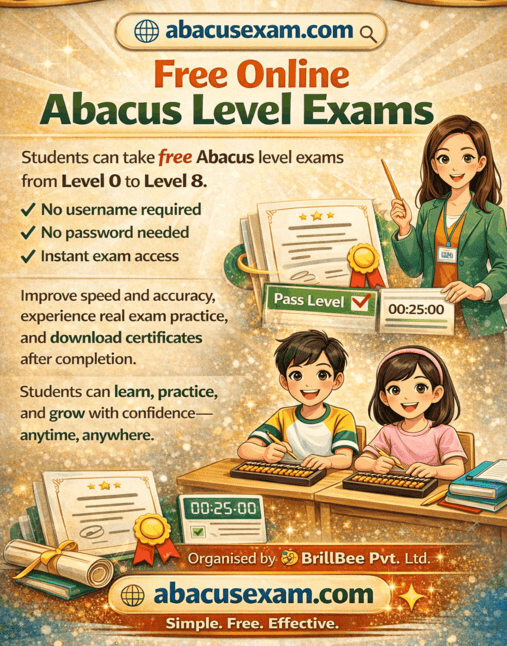
Structured learning paths with clear goals are incredibly motivating. Many of our students benefit from an All-in-One Abacus Learning System that combines practice, assessment, and friendly challenge. If you’re exploring options, you can learn more about structured progression through Abacus Level Exams or the excitement of Abacus Competitions.
Why Exam Preparation is More Than Just Speed
If you think an abacus exam is just a race against the clock, I’d like to invite you to look deeper. Over the years, I’ve noticed that the students who excel display a powerful combination of accuracy, composure, and strategic thinking. The exam is a milestone—a chance to solidify weeks of learning into a demonstrable skill.
The true benefit of this preparation is the discipline it instills. It’s about training the brain to focus under gentle pressure, a skill that transfers directly to school tests, presentations, and problem-solving in daily life.
The 4-Week Pre-Exam Blueprint: A Practical Timeline
Cramming is the enemy of abacus learning. The mental pathways for bead manipulation and visualization need time to become automatic. Here’s a relaxed, stage-by-stage approach I recommend.
- Weeks 4-3 Before Exam: Foundation Strengthening. This is the accuracy phase. Revisit older, simpler formulas to build effortless fluency. Identify one or two challenging areas (perhaps subtraction with borrow or mixed operations) and give them gentle, daily attention without stress.
- Weeks 2-1 Before Exam: Speed & Stamina. Introduce timed drills—short bursts of 5-minute focused practice. Begin simulating full-length practice tests once a week. This is also the critical period to intensify mental visualization practice. A key part of this phase is understanding abacus exam duration and time management tips to develop a sustainable pace.
- The Final Week: Consolidation & Confidence. Reduce overall practice volume. Shift focus to review and positive reinforcement. The goal is to enter the exam believing, “I know this.” Confidence now is more valuable than any new last-minute trick.
Core Best Practice Techniques Before Abacus Exams
Technique 1: The Power of Daily Micro-Practice
Marathon sessions lead to fatigue and frustration. Based on real classroom learning, 20-25 minutes of focused, daily practice is the golden rule. It’s like keeping a flame steadily lit rather than trying to reignite a bonfire every few days.
Use this time intentionally: correct yesterday’s errors, perfect a specific formula, or train your auditory skills. For the latter, audio-based practice is exceptional. Tools like the Abacus Audio Practice & 100-Level Challenge develop the ability to calculate from sound alone, strengthening mental imagery profoundly.
Technique 2: Simulating the “Exam Environment”
A common reason for exam-day anxiety is the unfamiliarity of the setting. The solution is to make it familiar.
About two weeks out, start creating “mock exam” conditions at home. Use an official practice sheet, set a strict timer, clear the table of distractions, and enforce exam silence. This process does wonders. It transforms the actual exam from a scary unknown into “just another practice session.” The muscle memory of the routine kicks in, allowing skill to shine through.
Technique 3: Mastering Mental Visualization (The Anzan Shift)
This is the heart of the abacus journey—the transition from physical tool to the mind’s eye. The pre-exam period is perfect for strengthening this muscle.
Start simply. After solving a problem on the physical abacus, close your eyes and replay the bead movements. Then, attempt a very easy problem using only the mental image. This skill builds gradually. When it clicks, it’s a transformative moment for a student. They realize the true power lies within their own focus. ✨
The Crucial Role of Parents & Teachers
Your support sets the emotional tone. Your calm assurance is the safety net that allows a child to take a confident leap.
- For Parents: Be the schedule-keeper and the cheerleader. Provide that consistent, quiet practice time. Praise the effort and perseverance you see. Your most powerful question is, “What did you learn in your practice today?”
- For Teachers: Frame the exam as a celebration of progress. Offer specific, kind feedback. Remind students of their journey from where they started. Your belief in them becomes their inner voice.
Let me share a truth we’ve witnessed consistently at Mission Abacus Private Limited: Students who practice regularly, appear for level exams, and participate in competitions show faster improvement in speed, accuracy, and confidence.
Building the Right Mindset: Confidence Over Perfection
Let me ask you a reflective question: What legacy do you want this exam to leave? A memory of stress, or a memory of proud achievement?
Nurture the latter. Teach students the language of self-encouragement: “I am prepared. I can handle this.” Help them understand that everyone makes small mistakes, and it’s the overall performance that counts. This mindset is, arguably, the most vital best practice technique before an abacus exam. It’s a gift that extends far beyond mathematics.

A Balanced View: When Abacus May Not Be Enough
Honest guidance is a mentor’s duty. The abacus is a phenomenal tool for building mental arithmetic speed, concentration, and logical sequencing. However, it is a specialized part of a broader mathematical education.
Its primary strength is in honing calculation. For deep conceptual understanding of why mathematical principles work—the realm of advanced algebra, geometry, and calculus—it works best alongside a strong school curriculum. It builds an unparalleled foundation for numerical fluency. To understand how these worlds connect, you can read more about how Abacus can help in school maths.
The aim is complementary, holistic development.
Final Week & Exam Day Checklist
Two Days Before:
- Do one light, encouraging mock test for familiarity.
- Prioritize a full night’s sleep—it’s crucial for cognitive function.
- Prepare your exam kit: abacus, pencils, eraser, admit card.
The Day Before:
- NO heavy practice. Let the mind integrate what it has learned.
- Opt for light physical activity or a fun, non-math related hobby.
- Visualise walking into the venue calmly and walking out smiling.
Exam Day:
- Have a light, nutritious breakfast.
- Arrive with time to spare to settle any nerves.
- In the exam hall, take one deep breath. Read instructions carefully. Focus on your own paper with quiet confidence. You have done the work. Now, trust it. 🚀
For learners seeking a clear path, an All-in-One Abacus Learning System that integrates practice, level assessments, and motivational challenges can be incredibly supportive. It turns preparation into a engaging journey.
Understand the Full Learning Journey from Beginner to Advanced
Frequently Asked Questions (FAQs)
Can my child start abacus exam preparation if they are a complete beginner?
Absolutely! Every expert was once a beginner. The key is to start at the correct foundational level and focus on concept mastery before speed. The exam system is designed to be progressive, building confidence one step at a time.
Is it worth entering my child in an abacus competition before an exam?
Yes, but with the right perspective. Competitions are excellent for building speed under a different kind of positive pressure and for experiencing a collaborative learning environment. They are a fantastic motivator and supplement to exam preparation.
How long does it typically take to prepare for one level exam?
With regular practice (4-5 days a week), most students are ready for a level exam in 3-4 months. Simpler levels may take less time, while advanced levels requiring strong mental visualization may require more patience. Consistency is more important than speed.
What if my child gets very nervous and forgets everything during the exam?
First, normalise the feeling—it happens to everyone. The mock exam practice (Technique 2) is the best defence. Teach them a “reset button”: if they freeze, they should put their pencil down, take three slow breaths, and skip to the next, easiest problem to rebuild momentum.
Can adults benefit from taking abacus exams?
Without a doubt! Adults often experience remarkable benefits in mental agility, focus, and even stress reduction. The exam provides a structured, rewarding goal that makes the practice purposeful. It’s a wonderful workout for the brain at any age.

Are online abacus exams as effective as in-person ones?
They serve different, complementary purposes. In-person exams build formal exam temperament and focus. Online exams offer flexibility and are excellent for regular skill benchmarking. A blend of both provides the most well-rounded preparation experience.
I hope this guide serves as a trusted companion on your preparation journey. Remember, the clicks of the abacus beads are more than just calculations; they are the sound of a growing mind learning focus, patience, and self-belief.
Your role is to nurture that process. Use these techniques as a flexible framework, adapting it to your child’s unique rhythm. The goal is not just a certificate, but a confident learner.
If you are an educator passionate about guiding students with this mindful approach, we periodically host a FREE Abacus Teacher Training workshop to deepen these mentoring skills. It’s about passing on this craft with intention and heart.
Wishing you and your student a experience filled with learning and personal triumph. Walk in with confidence.
Warmly,
Ashwani Sharma ✍️
Director, Mission Abacus Private Limited
Jaipur, India