⚖️ Abacus vs Vedic Maths: Which One Should Your Child Learn First?
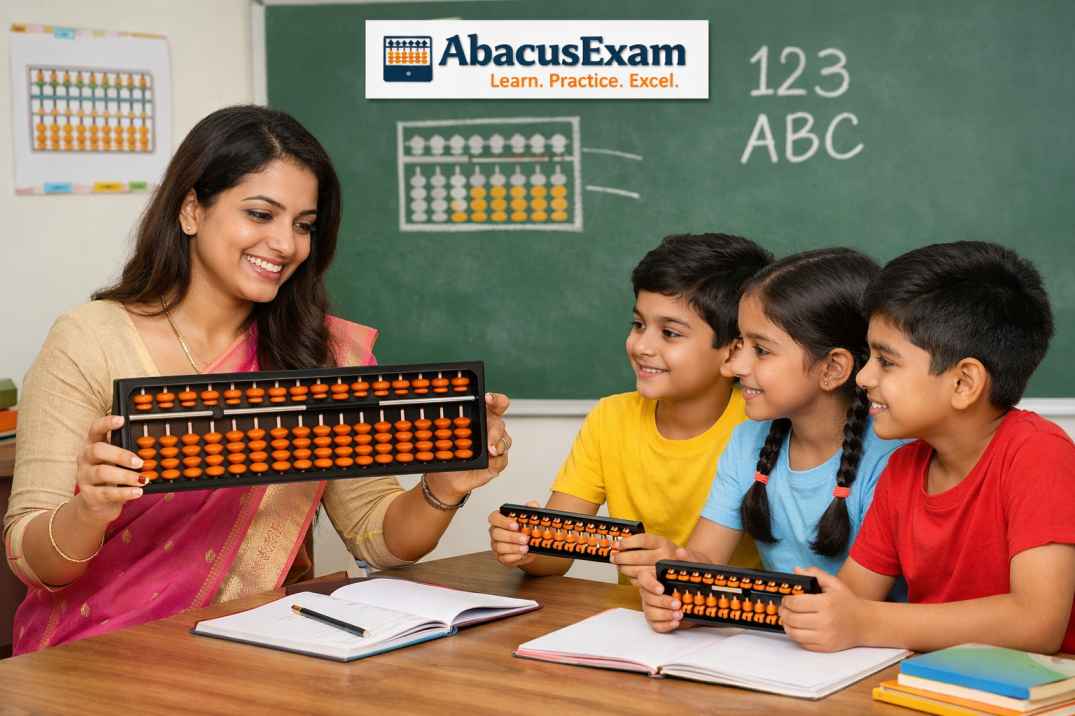
Different tools, different strengths – choose based on your child’s age
🤔 You’ve heard about both abacus and Vedic maths. But what’s the real difference? And more importantly – which one should your child start with?
Many parents enroll their kids in both, only to see confusion and burnout. Others pick the wrong one for their child’s age and get frustrated with slow progress.
In this guide, I’ll break down the key differences and give you a clear recommendation based on 10+ years of experience training over 5000 students worldwide.
📊 Key Differences at a Glance
| Aspect | Abacus | Vedic Maths |
|---|---|---|
| Core method | Physical tool (bead frame) → mental visualization | 16 sutras (formulas) + sub-sutras |
| Age suitability | 5-12 years (ideal 5-8) | 10+ years (needs basic arithmetic fluency) |
| Learning style | Kinesthetic, visual, auditory (multisensory) | Abstract, memory-based (memorize formulas) |
| What it builds | Working memory, focus, fine motor skills, number sense | Calculation shortcuts, speed for specific problems |
| Time to see results | 2-3 months for basic mental math | Can learn a sutra in one session, but mastery takes practice |
| Requires external tool | Yes (physical abacus for first 4-6 months) | No – only mental |

🎯 Which One for Which Age?
Ages 5-7: Start with abacus. Young children need concrete, tactile learning. The bead frame gives them something to touch. Vedic maths formulas are too abstract at this age.
Ages 8-10: Continue abacus. By now they should be doing mental math without the frame. Introduce very simple Vedic shortcuts (like “all from 9 and last from 10” for subtraction) only if they’re advanced.
Ages 11+: This is the ideal time for Vedic maths. They already have number sense from abacus. Now they can learn shortcuts to become lightning fast. Many of my students learn both.
✅❌ Pros and Cons of Each Method
Abacus – Pros: Builds deep number sense, improves concentration, works for all types of learners, fun and engaging, also develops fine motor skills, transfers to other subjects.
Abacus – Cons: Requires daily practice (15-20 min), takes months to see full benefits, physical kit needed, less focus on advanced shortcuts.
Vedic Maths – Pros: Extremely fast for specific problems, no tools needed, can be learned in short modules, impressive for competitions, works well for older children and adults.
Vedic Maths – Cons: Requires memorization of many sutras, less effective for children under 10, doesn’t build number visualization, can become rote if not understood, not as engaging for young kids.
📚 Recommended Learning Sequence
Based on my experience training thousands of students across six continents, here’s the optimal path:
Step 1 (ages 5-7): Abacus foundation – learn bead movement, single/double digit sums on physical abacus.
Step 2 (ages 7-9): Abacus mental math – transition to visualization, solve sums without frame.
Step 3 (ages 9-10): Continue abacus advanced levels (multiplication, division, decimals).
Step 4 (ages 10-11): Introduce Vedic maths – start with 2-3 simple sutras that complement abacus skills.
Step 5 (ages 11+): Both methods together – use abacus for number sense and Vedic for speed tricks.
“My son did abacus from age 6 to 9. At 10, he started Vedic maths. He’s now 12 and can solve complex calculations faster than any adult I know. The foundation from abacus made Vedic effortless.”
– Parent, USA💪 Not sure which is right for your child? A free demo can help assess their level.
🎯 Book a free assessment →❓ Frequently Asked Questions
Can my child learn both at the same time?
Yes, but only if they are already comfortable with abacus (at least level 3-4). Learning both from scratch can be confusing.
Which is better for competitive exams like Olympiads?
Both help. Abacus builds speed for basic calculations. Vedic maths provides shortcuts for specific problem types. Ideally, learn both over time.
Is Vedic maths recognized in schools?
Not formally, but many schools allow it as an enrichment method. Some Olympiad trainers recommend it.
My child is 12 and hasn’t learned abacus. Should they start now?
They can, but the benefits for visualization will be less dramatic. Consider starting with Vedic maths directly, or do a shortened abacus course (6 months).
Which method is more fun for kids?
Abacus is generally more fun for younger kids because of the hands-on beads. Vedic maths can feel like memorizing tricks – some kids love it, others find it dry.
💛 Give your child the right start – with the right method for their age.
I’ve helped thousands of parents worldwide make this decision. Let me help you too – with a free, no-pressure consultation.
📲 Get personalized advice →