🧠 Abacus vs Mental Math: What’s the Difference?
Abacus is a tool; mental math is the skill you build with it
🤔 You’ve heard “abacus” and “mental math” used interchangeably. But are they the same thing?
Many parents confuse the two. Some think abacus is outdated, while mental math is modern. Others think you can learn mental math without any tool.
In this guide, I’ll clear up the confusion – and explain why understanding the difference matters for your child’s learning.
📖 Clear Definitions – Abacus vs Mental Math
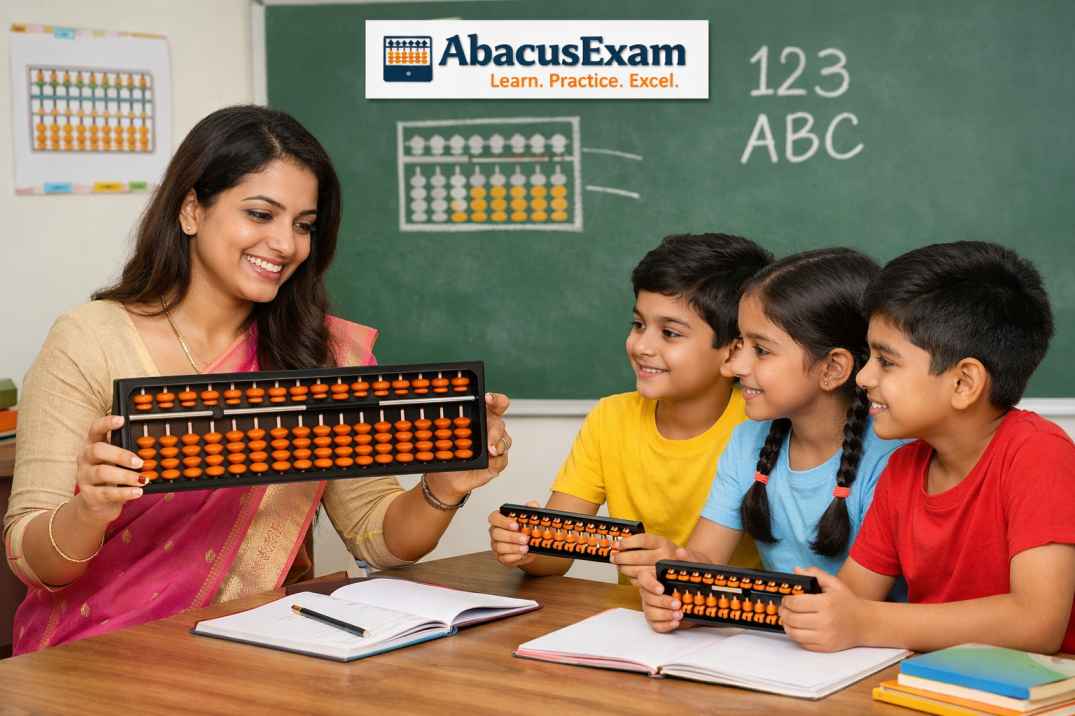
Abacus: A physical counting frame with rods and beads. Children slide beads to perform addition, subtraction, multiplication, and division. It’s a concrete tool.
Mental math: The ability to solve mathematical problems entirely in your head, without writing or using any external device (including abacus). It’s a cognitive skill.
Think of it like this: A bicycle is a tool. Being able to balance and ride is a skill. The abacus is the bicycle; mental math is the skill of riding without thinking about balance.

🔗 How They Relate: The Abacus → Mental Math Pathway
Here’s the key insight: Abacus training is a structured method to build mental math skills. The child does not stay on the physical abacus forever.
Phase 1 (0-4 months): Physical abacus only. Child moves beads with fingers.
Phase 2 (4-8 months): Transition. Child begins to visualize beads while occasionally using the physical frame.
Phase 3 (8+ months): Pure mental math. Child no longer needs the abacus – they can calculate in their head using the mental image of beads.
So abacus is the training wheels. Mental math is the final destination. Without abacus training, mental math is still possible (through other methods), but it’s often slower and less systematic.
📊 Side-by-Side Comparison Table
| Aspect | Abacus (Tool/Method) | Mental Math (Skill) |
|---|---|---|
| What is it? | Physical frame with beads | Ability to calculate in head |
| Tangible? | Yes – you can touch it | No – it’s a cognitive ability |
| How is it learned? | Through structured classes and practice | Developed through various methods (abacus, Vedic, practice) |
| Age suitability | 5-12 years optimal | Any age (with appropriate method) |
| End goal | To build mental math | Faster, more accurate calculation |
| Is it necessary? | No, but it’s highly effective | Yes – useful for everyone |
🔄 Other Ways to Learn Mental Math (Without Abacus)
Abacus isn’t the only path to mental math. Other methods include:
- Vedic maths: Sutras (formulas) for mental shortcuts. Best for ages 10+.
- Flashcards & drills: Rote memorization of math facts. Works but less engaging.
- Mental math apps: Gamified practice. Good for reinforcement, not initial learning.
- Everyday practice: Mental calculation during shopping, cooking, etc.
However, abacus remains the most systematic method for young children because it builds number visualization from the ground up.
💪 Want your child to master mental math? Start with abacus training.
🎯 Book a free demo →❓ Frequently Asked Questions
Can a child learn mental math without abacus?
Yes, through Vedic maths, flashcards, or practice. But abacus is the most effective for ages 5-10.
Do you need to keep the abacus forever?
No. After 6-12 months, most children transition to pure mental math and rarely use the physical frame again.
Is abacus just for young kids?
Mostly. For older kids (12+), Vedic maths or direct mental math drills may be more efficient.
Can adults learn mental math through abacus?
Yes, but the brain’s plasticity is lower. Results may be slower. Still possible.
Which is faster – abacus-trained mental math or Vedic maths?
For basic arithmetic, abacus-trained children are extremely fast. For complex multi-digit calculations, Vedic has clever shortcuts. Many experts learn both.
💛 Give your child the gift of mental math – the abacus way.
I’ve seen thousands of children go from clumsy bead-movers to lightning-fast mental calculators. Let me show you how.
📲 Start your child’s mental math journey →