Abacus Exams for Age 5–12: Parent’s Complete Guide

Welcome! I’m Ashwani Sharma, Director at Mission Abacus Private Limited in Jaipur, India. From my years mentoring young learners and their families, I’ve seen how abacus exams for age 5–12 can spark a real love for numbers while building essential skills. In this parent’s complete guide, we’ll walk through everything you need to know about these exams, from what they involve to how they fit into your child’s growth. It’s all about honest insights to help you decide if this path feels right for your family.
Whether you’re a parent in the US navigating school pressures, a teacher in Australia seeking fresh tools, or anyone from India, the UK, Canada, New Zealand, Czechia, UAE, Qatar, or Norway exploring options, this guide is here to support you. Let’s make sense of abacus exams for age 5–12 together, step by step.
Table of Contents
- What Are Abacus Exams for Kids?
- The Basics Explained
- Why Focus on Ages 5–12?
- Types of Abacus Exams Available
- Level-Based Assessments
- Competitive Olympiads
- Preparing Your Child for Abacus Exams
- Daily Practice Ideas
- Building Mental Skills
- Benefits for Children and Families
- Skill Development
- Long-Term Advantages
- Practical Tips for Parents
- When Abacus Exams May Not Be Enough
- Integrating with Everyday Learning
- FAQs
What Are Abacus Exams for Kids?

Abacus exams test a child’s ability to use this ancient tool for calculations, often moving to mental math as they advance. They’re not like regular school tests—they’re more about progress and fun challenges.
For kids aged 5–12, these exams build confidence in maths step by step. Over the years, I’ve noticed how they turn abstract numbers into something tangible and exciting.
It’s reassuring for parents to know they’re designed to be age-appropriate, focusing on growth rather than perfection.
The Basics Explained
An abacus is a frame with beads that represent numbers. Exams assess how well kids manipulate them for addition, subtraction, and more.
Beginners start with simple tasks, like counting beads. As they progress, exams include timed sections to encourage speed.
In my experience working with students and teachers, this hands-on approach makes learning feel like play, especially for young ones.
Why Focus on Ages 5–12?
This age range is ideal because kids’ brains are wired for quick learning. From 5, they can grasp basics; by 12, they’re ready for complex mental calculations.
Experts suggest starting around 5–7 for the best results, as fine motor skills and focus develop rapidly.
Globally, programs tailor to this group, helping with challenges like building math confidence amid online learning demands.
Types of Abacus Exams Available
Abacus exams come in various forms, from structured levels to exciting competitions. They’re accessible worldwide, often online for international families.
Choose based on your child’s interest—some prefer quiet assessments, others thrive in group events.
Based on real classroom learning, mixing both types keeps motivation high.
Level-Based Assessments
These are progressive exams, like modules in programs such as SIP Abacus or UCMAS. Kids advance from junior to advanced levels.
Exams might include written tests or demonstrations, lasting 10–15 minutes. They’re great for tracking personal growth.
For time management, check these abacus exam duration & time management tips to prepare smoothly.
Competitive Olympiads

Think International Abacus Olympiad or similar events. These are for ages 5–14, with categories by age and skill.
Online formats make them perfect for kids in Canada or the UAE. They involve timed rounds, fostering quick thinking.
Students who practice regularly, appear for level exams, and participate in competitions show faster improvement in speed, accuracy, and confidence.
Preparing Your Child for Abacus Exams
Preparation is key, but keep it light-hearted. Start with short sessions to avoid overwhelm.
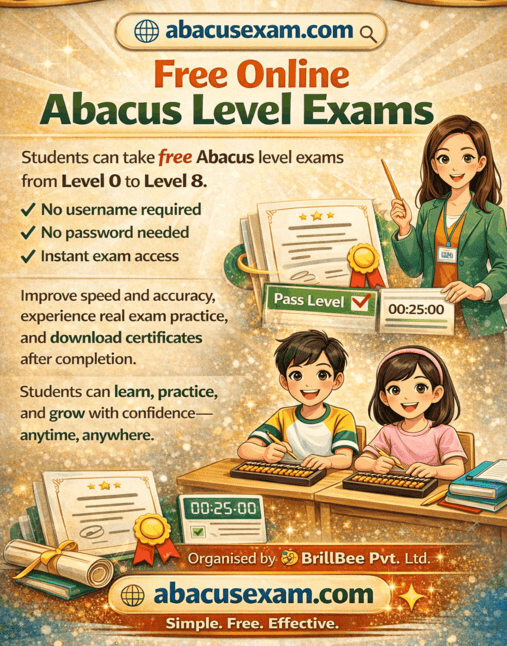
Use resources like our All-in-One Abacus Learning System, featuring the Abacus Competition Platform, Abacus Level Exam Platform, and Abacus Audio Practice & 100-Level Challenge. They’re helpful for building skills gradually.
Encourage consistency—it’s the quiet force behind success.
Daily Practice Ideas
Aim for 10–15 minutes a day. Mix bead work with mental visualization games.
For younger kids, turn it into stories: “Move the beads to count the apples!”
Over the years, I’ve noticed this routine helps kids from New Zealand or Norway overcome screen fatigue by offering a tactile break.
Building Mental Skills
As exams approach, focus on mental abacus—imagining the tool in their mind.
Practice with flashcards or apps, but balance with offline time.
It’s motivating to see a 7-year-old master this, their face beaming with pride.
Benefits for Children and Families
Abacus exams for age 5–12 offer more than math prowess. They nurture focus, memory, and problem-solving.
Parents often share how it eases homework stress, while teachers note engaged classrooms.
It’s a confidence booster, especially for those facing math anxiety in school.
Skill Development
Kids gain speed in calculations, but also better concentration across subjects.
Visual-spatial skills improve, aiding science or art.
In sessions I’ve guided, children develop resilience, learning from small setbacks.
Long-Term Advantages
These skills support lifelong learning, from exams in the UK to careers in Qatar.
It complements school work—explore how abacus can help in school maths for insights.
Families bond over practice, creating shared moments of achievement.
Have you considered how abacus exams might fit your child’s unique strengths? Reflect on that—it could open new doors. 💡
Practical Tips for Parents

Observe your child’s readiness: Do they enjoy numbers or puzzles?
Choose programs with trained instructors and flexible schedules, online or in-person.
Set realistic expectations—progress might take months, but celebrate small wins.
For teachers, free abacus teacher training can be a gentle way to incorporate this into lessons. 🚀
Involve siblings or friends for fun group sessions.
When Abacus Exams May Not Be Enough
Honestly, abacus isn’t for every child. If your little one has learning differences needing specialized support, it might complement but not replace other therapies.
For advanced math beyond basics, traditional methods could be necessary.
In my experience, some kids thrive more in creative outlets—respect that, and avoid pushing.
Integrating with Everyday Learning
Blend abacus with daily life: Use it for grocery counting or game scores.
It tackles modern challenges like online learning overload by providing a device-free alternative.
Global parents in Czechia or Australia adapt it for hybrid education, fostering independence.
Share this guide with other families via the social buttons below—spreading knowledge helps everyone. 🌍
FAQs
Can kids as young as 5 take abacus exams?
Yes, many programs start at 5, with simple assessments. It’s gentle and fun, building basics without pressure. Watch for readiness signs like interest in counting.
How long does it take for a child to prepare for abacus exams?
Usually 2–3 months for beginner levels, longer for advanced. Consistent short practices work best. Patience pays off as skills grow naturally.
Is enrolling in abacus exams worth it for my 8-year-old?
If they show curiosity in math, yes—it boosts focus and confidence. Weigh against their interests; it’s valuable but not essential for everyone.
Can abacus exams help with school performance?
They often do, enhancing mental math and problem-solving. Many parents see improvements in grades. Resources on integration can guide you further.
What if my child struggles during abacus exams?
It’s common at first—encourage breaks and positive reinforcement. Adjust pace to their needs. Over time, most gain comfort and enjoyment.
Are abacus exams suitable for international school kids?
Absolutely, with online options fitting diverse curricula. Families worldwide use them to build universal skills like concentration, regardless of location.
Thanks for spending time with this guide! As Ashwani Sharma, drawing from my journey at Mission Abacus Private Limited, I hope it empowers you to nurture your child’s potential. Every learner’s path is unique—embrace it with warmth. 🎓 🧮