
Abacus Exam Syllabus: What Students Should Really Learn 🎓🧮
Welcome! I’m Ashwani Sharma, and for many years now, I’ve been closely involved with abacus learning as part of my work at Mission Abacus Private Limited. From classrooms in Jaipur to online sessions with families in the UK, the US, the Middle East, and Europe, I’ve heard one question repeatedly from parents and teachers:
“What exactly should a child learn from the abacus exam syllabus?”
This blog is my honest attempt to answer that question. We’ll talk calmly and clearly about the abacus exam syllabus: what students should really learn, not what looks impressive on paper, but what genuinely helps children grow in confidence, clarity, and thinking ability 🌍.
📘 Table of Contents
- Understanding the Purpose of an Abacus Exam Syllabus
- What an Abacus Exam Syllabus Is (and What It Is Not)
- Abacus Exam Syllabus: What Students Should Really Learn
- Core Skills That Matter More Than Speed
- Mental Math vs Mechanical Practice
- Role of Visualization and Finger Movement
- How Levels and Exams Fit Into the Syllabus
- Practice, Audio Learning, and Rhythm
- Competitions and Their Place in Learning
- Online Learning, Offline Learning, and the Same Syllabus
- When Abacus May Not Be Enough
- A Reflective Question for Parents
- Practical Tips for Parents and Teachers
- Final Thoughts from Experience
- FAQs
- SEO Details

Understanding the Purpose of an Abacus Exam Syllabus
Before we discuss content, let’s understand intent.
An abacus exam syllabus is not a checklist to rush through.
It is a learning map.
In my experience working with students and teachers, children who understand why they are learning something perform far better than those who simply prepare to “clear the exam.”
The syllabus exists to guide growth—not to create pressure 📘.
What an Abacus Exam Syllabus Is (and What It Is Not)
An abacus exam syllabus is:
- A structured progression of skills
- A balance of practice and thinking
- A way to assess readiness for the next level
An abacus exam syllabus is not:
- A speed race
- A comparison tool
- A shortcut to maths excellence
Over the years, I’ve noticed that confusion begins when adults focus more on certificates than capability.
Abacus Exam Syllabus: What Students Should Really Learn
This is the heart of our discussion.
When we talk about the abacus exam syllabus: what students should really learn, we must look beyond written patterns and timed tests.
The syllabus should help students develop thinking habits, not just faster fingers ✍️.
Core Skills That Matter More Than Speed
Speed looks attractive.
Accuracy builds confidence.
Based on real classroom learning, a strong abacus syllabus should help students:
- Understand number relationships
- Maintain accuracy under time limits
- Stay calm while calculating
Children who chase speed too early often lose clarity.
Children who build clarity first gain speed naturally 🚀.
Accuracy Before Anything Else
In almost every country I’ve worked with—India, Canada, the UAE, or Australia—the pattern is the same.
Children who:
- Pause before answering
- Self-correct mistakes
- Reflect on wrong answers
are truly learning.
That is real syllabus success 💡.
Mental Math vs Mechanical Practice
One important thing parents often ask is:
“Is my child really calculating mentally, or just following patterns?”
A meaningful abacus exam syllabus gradually shifts learners:
- From physical beads 🧮
- To mental visualization
- To confident mental math
This transition matters far more than finishing levels quickly.
Visualization: The Invisible Skill

A strong syllabus trains the mind to “see” numbers.
When a child:
- Closes eyes briefly before answering
- Moves fingers lightly in the air
- Explains how they reached an answer
It shows visualization is developing.
In my experience, this invisible skill is what truly supports school maths later.
Role of Finger Movement and Body Memory
Finger movement is not childish.
It is neurological training.
A good abacus exam syllabus respects:
- Finger coordination
- Rhythm in movement
- Body-memory support
Children who are allowed this transition learn faster and more comfortably.
How Levels and Exams Fit Into the Syllabus
Levels exist for structure, not stress.
A healthy syllabus:
- Introduces difficulty gradually
- Revises earlier concepts
- Tests understanding, not memorization
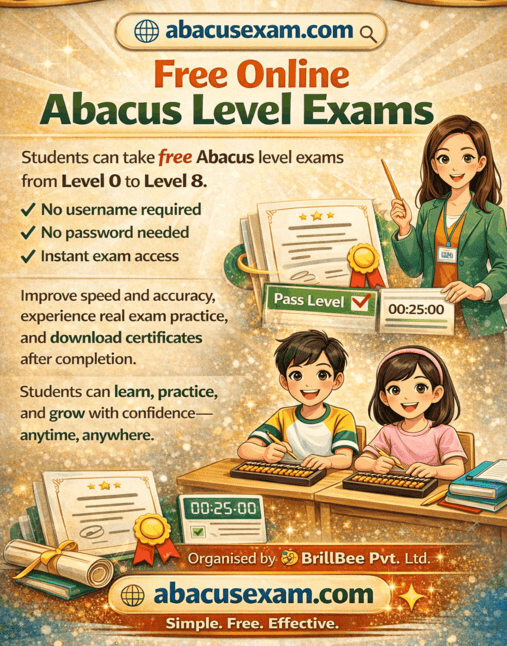
Using structured exam systems like the All-in-One Abacus Learning System helps bring clarity.
This system includes:
📝 Abacus Level Exam Platform – https://abacusexam.com
🏅 Abacus Competition Platform – https://abacusshiksha.com
🎧 Abacus Audio Practice & 100-Level Challenge – https://abacuswala.com
Together, they support learning, assessment, and confidence—when used patiently.
Understanding Time and Exam Readiness
Time management is part of the syllabus, not an extra skill.
Parents often underestimate this.
You may find it useful to understand abacus exam duration and time management tips, which are explained clearly here:
👉 https://abacusexam.com/abacus-exam-levels-explained-beginner-to-advanced/
Children who manage time calmly usually understand concepts well.
Practice, Audio Learning, and Rhythm
Practice does not mean long hours.
It means regular contact with numbers.
Audio practice, in particular, helps children:
- Improve listening skills
- Reduce screen dependency
- Build mental alertness
Over the years, I’ve noticed that students who include audio practice respond faster and stay more focused 🌍.
Competitions and Their Place in Learning
Competitions are optional—but useful.
They are not about ranking children.
They are about exposing them to:
- Pressure handling
- Time discipline
- Self-evaluation
That’s why a balanced syllabus includes occasional competitions, not frequent ones.
Remember this truth:
Students who practice regularly, appear for level exams, and participate in competitions show faster improvement in speed, accuracy, and confidence.
Online Learning, Offline Learning, and the Same Syllabus
One question I hear globally is:
“Does the syllabus change for online learners?”
The answer is no.
The abacus exam syllabus remains the same whether learning happens:
- Online
- Offline
- In blended formats
What changes is support style, not learning goals.
Online learners may need more guidance with screen fatigue and focus.
Offline learners may need more flexibility and encouragement.
When Abacus May Not Be Enough
This is an honest and necessary section.
Abacus helps with:
- Mental calculation
- Focus
- Confidence
But it does not replace:
- School maths concepts
- Word problem understanding
- Daily academic study
Parents sometimes expect abacus alone to fix everything.
That expectation needs gentle correction.
You may reflect on this question many families ask:
Can abacus help in school maths and overall confidence?
👉 https://abacusexam.com/abacus-exam-levels-explained-beginner-to-advanced/
Limitations Parents and Adults Should Understand
No syllabus can work without:
- Regular practice
- Emotional readiness
- Supportive guidance
If a child is tired, anxious, or overloaded, even the best syllabus pauses.
That pause is not failure.
It is care 💡.
A Reflective Question for Parents
Before focusing on exams or levels, ask yourself:
“Is my child learning to think—or just learning to finish?”
The answer often changes how we support them.
Practical Tips for Parents and Teachers
A few calm reminders from experience:
- Don’t compare children
- Respect individual pace
- Celebrate small improvements
- Review readiness every few months
Learning stays joyful when expectations stay realistic 🎓.
A Gentle Note for Aspiring Teachers
If you are a parent or educator exploring deeper understanding, there are free abacus teacher training opportunities available for those who want to learn pedagogy, not just methods.
Learning how to teach often improves how we guide our own children.
Final Thoughts from Experience
After years of observing learners across countries and cultures, I can say this with quiet confidence:
A good abacus exam syllabus does not create fast calculators.
It creates calm thinkers.
When students truly learn what the syllabus intends—clarity, control, and confidence—results follow naturally.
Warm regards,
Ashwani Sharma 🌍✨
❓ Frequently Asked Questions
Can beginners understand the abacus exam syllabus easily?
Yes. When explained gently, the syllabus is simple and skill-based, not technical.
Is it worth focusing deeply on the syllabus instead of speed?
Absolutely. Strong foundations lead to long-term speed and confidence.
How long does it take to complete one abacus syllabus level?
It varies. Some children need months, others longer. Pace matters less than readiness.
Can online students follow the same abacus syllabus?
Yes. The learning goals remain the same for online and offline learners.
Is abacus syllabus useful for adults or teens?
Yes. Mental math and focus skills benefit learners of all ages.
Can exams be skipped if practice is strong?
Exams help measure readiness, but learning quality always comes first.