Abacus Exam Pattern Explained for International Students 🌍🧮
Welcome! I’m Ashwani Sharma, and for many years now, I’ve been working closely with children, parents, and teachers through Mission Abacus Private Limited. In this blog, I want to gently walk you through the Abacus Exam Pattern Explained for International Students, in a way that feels clear, calm, and practical—not confusing or overwhelming.
If you are a parent wondering “What exactly happens in an abacus exam?”,
a teacher trying to guide students confidently,
or a beginner exploring whether abacus learning has global value—
you are in the right place.
Within the first few months of teaching international learners, I realised something important:
most confusion around abacus exams comes not from difficulty, but from lack of clarity.
Once the pattern is understood, anxiety reduces automatically.
Let’s begin slowly and clearly.
📘 Table of Contents
- Understanding the Purpose of Abacus Exams
- What Is the Abacus Exam Pattern Explained for International Students?
- Global Structure of Abacus Level Exams
- Levels in Abacus Exams: What Do They Mean?
- Written, Mental, and Audio-Based Formats
- Time Duration and Question Design
- Evaluation Criteria: Speed, Accuracy, and Focus
- How International Online Exams Are Conducted
- Benefits of Abacus Exams for Students 🌱
- How Parents Can Support Exam Preparation
- What Teachers Should Understand About Exam Readiness
- When Abacus May Not Be Enough ⚖️
- Real Classroom Observations from Experience
- The Role of the All-in-One Abacus Learning System
- A Reflective Question for You ✍️
- Free Abacus Teacher Training: A Gentle Note
- Frequently Asked Questions (FAQs)
- A Personal Closing Note
Understanding the Purpose of Abacus Exams 🎓
Before we discuss patterns, timings, or levels, it’s important to understand why abacus exams exist.
Abacus exams are not meant to pressure children.
They are designed to measure progress, not perfection.
In my experience working with students and teachers across different countries, I’ve noticed that children perform better when exams are treated as checkpoints rather than judgements.
The core goals of abacus exams are:
- To build mental calculation confidence
- To improve focus and visualisation
- To encourage disciplined practice habits
Whether a student is in India, the UK, Canada, or the UAE, the intention remains the same.
What Is the Abacus Exam Pattern Explained for International Students?
When we talk about the Abacus Exam Pattern Explained for International Students, we are referring to a globally adaptable structure that works both offline and online.
Most international abacus exams follow a similar framework:
- Level-based progression
- Fixed time duration
- Mix of written and mental calculations
- Gradual increase in difficulty
The pattern is designed so that language, country, or school curriculum does not become a barrier.
This is why abacus learning travels so well across borders 🌍.
Global Structure of Abacus Level Exams 🌍

Across countries like Australia, New Zealand, Czechia, Norway, Qatar, and the US, abacus exams usually follow a level system rather than age-based grading.
Each level tests:
- Number range handling
- Speed under time limits
- Accuracy without guesswork
The structure is consistent enough to feel familiar, yet flexible enough to suit online learners.
This global consistency is what makes the Abacus Exam Pattern Explained for International Students so reliable.
Levels in Abacus Exams: What Do They Mean?
H3: Beginner to Advanced Progression
Abacus exams are divided into levels such as:
- Beginner / Foundation
- Intermediate
- Advanced
Each level builds on the previous one.
H4: Why Levels Matter More Than Age
A 7-year-old and a 12-year-old may appear in the same level exam—and that’s perfectly fine.
Over the years, I’ve noticed that readiness matters more than age.
When students move levels too fast, confidence drops.
When they move at the right pace, growth becomes visible.

Written, Mental, and Audio-Based Formats 🧠
One beautiful aspect of the abacus exam pattern is variety.
Most exams include:
- Written calculations (using abacus initially)
- Mental math (visualising the abacus)
- Audio-based practice for listening and response speed
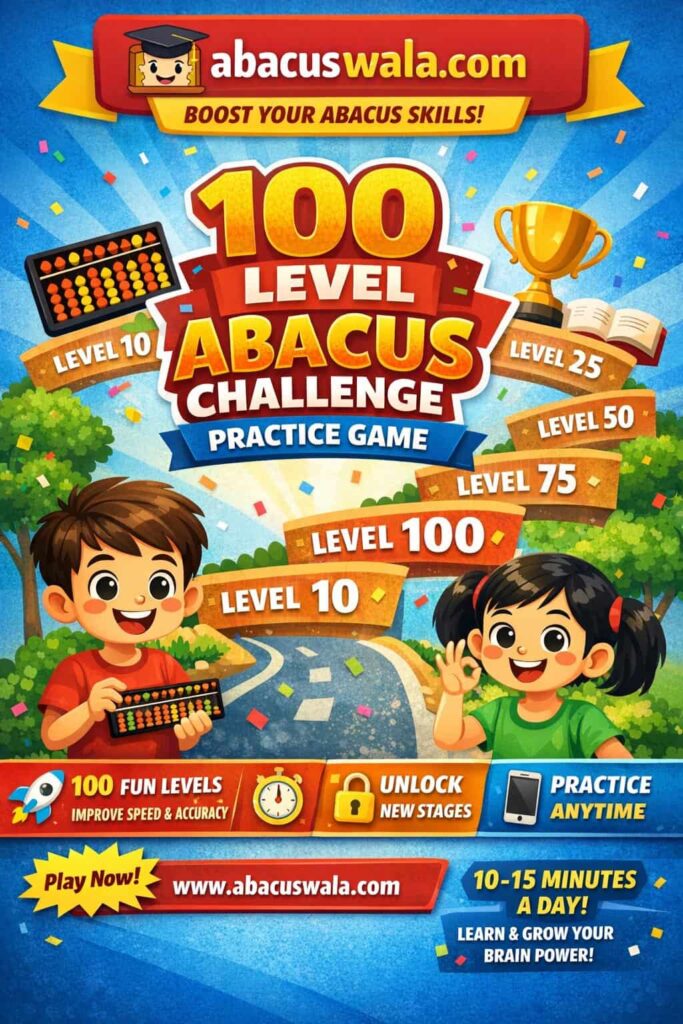
For audio and advanced mental challenges, many learners use platforms like https://abacuswala.com, which supports audio practice and 100-level challenges.
This balanced format ensures that learning is not mechanical—it becomes mental.
Time Duration and Question Design ⏱️
Abacus exams are time-bound, but not rushed.
Typically:
- Duration ranges from 8 to 15 minutes
- Question count increases with level
- Time per question decreases gradually
If time management worries you, I recommend reading this helpful guide on abacus exam duration and time management strategies, which explains pacing in a very practical way.
The intention is not speed alone—it is controlled speed with calm thinking.
Evaluation Criteria: Speed, Accuracy, and Focus 💡
Most international abacus exams evaluate students on:
- Correct answers
- Completion within time
- Consistency
Marks are usually not negative.
Accuracy is valued more than blind speed.
Students who practice regularly, appear for level exams, and participate in competitions show faster improvement in speed, accuracy, and confidence.
This is something I’ve seen repeatedly over the years.
How International Online Exams Are Conducted 💻
With online learning becoming common globally, abacus exams have adapted smoothly.
Online exams usually involve:
- Webcam monitoring
- On-screen question display
- Answer submission on paper or digital sheets
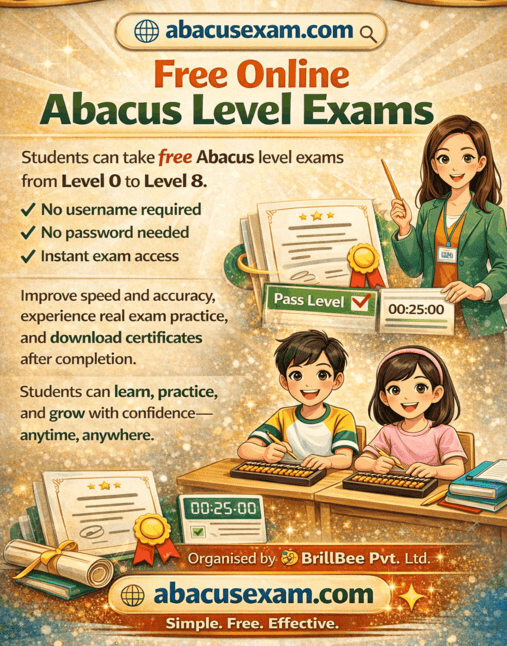
Platforms such as https://abacusexam.com specialise in structured abacus level exams suitable for international learners.
The experience is surprisingly calm when students are prepared well.
Benefits of Abacus Exams for Students 🚀
For students, abacus exams offer:
- Confidence in numbers
- Improved memory and attention
- Reduced maths fear
Many parents later notice that children perform better even in school maths.
If you’re curious, this article on how abacus supports school mathematics learning explains the connection beautifully.
How Parents Can Support Exam Preparation 👨👩👧
Parents don’t need to teach maths to help.

Simple support includes:
- Encouraging regular short practice
- Avoiding exam pressure
- Praising effort, not just scores
Based on real classroom learning, children perform best when parents stay calm and positive.
What Teachers Should Understand About Exam Readiness ✍️
Teachers play a crucial role.
Exam readiness is not about finishing the syllabus.
It is about:
- Observation
- Confidence level
- Consistency
In my experience, teachers who delay exams slightly often see better long-term results.
When Abacus May Not Be Enough ⚖️
It’s important to be honest.
Abacus is powerful, but:
- It does not replace conceptual maths teaching
- It needs regular practice
- It works best alongside school learning
When expectations are realistic, abacus becomes a strength—not a burden.
Real Classroom Observations from Experience 📘
Over the years, I’ve noticed that students who enjoy the process perform better than those chasing certificates.
Exams should support learning, not dominate it.
That mindset makes all the difference.

The Role of the All-in-One Abacus Learning System 🧩
Many international learners now use an All-in-One Abacus Learning System, which includes:
- Practice and competitions via https://abacusshiksha.com
- Level exams through https://abacusexam.com
- Audio and mental challenges on https://abacuswala.com
When used mindfully, such systems bring structure without pressure.
A Reflective Question for You ✍️
Are we preparing children to pass exams,
or helping them build confidence for life?
Take a moment to think about that.
Free Abacus Teacher Training – A Gentle Note 🎓
For educators interested in understanding abacus exams deeply, structured free abacus teacher training can be a meaningful starting point.
At Mission Abacus Private Limited, we’ve seen teachers grow more confident simply by understanding the learning journey better.
Frequently Asked Questions (FAQs)
Can international students appear for abacus exams online?
Yes. Most platforms support online exams with global access and clear guidelines.
Is the abacus exam pattern the same worldwide?
The core structure is similar, though minor variations may exist by platform.
How long does it take to prepare for one level?
Usually 3–6 months, depending on practice consistency.
Is abacus useful beyond exams?
Absolutely. It improves focus, confidence, and mental clarity.
Can adults or seniors take abacus exams?
Yes. Abacus learning is age-independent and beneficial lifelong.
Is it worth appearing for abacus competitions?
Competitions help with confidence and speed, but should remain optional.
A Personal Closing Note 🌱
If there’s one thing I’ve learned over the years, it’s this:
children don’t fear exams—they fear confusion.
Once the Abacus Exam Pattern Explained for International Students becomes clear, learning feels lighter and more joyful.
Thank you for spending this time with me.
May your abacus journey be calm, confident, and meaningful. 🌍🧮
— Ashwani Sharma