How to Prepare Your Child for National Abacus Olympiad Exams
- Introduction
- Why Olympiad Preparation Is Different
- Understanding the Olympiad Format
- 6-Month Olympiad Preparation Plan
- Success Story: From Participant to National Medalist
- Benefits of Olympiad Participation
- Speed vs Accuracy – The Olympiad Balance
- Expert Tips
- Do’s & Don’ts
- What Results to Expect
- Common Mistakes
- FAQs
- Summary
🏆 Introduction: Beyond Regular Abacus Classes
National Abacus Olympiads are the ultimate test of mental math speed, accuracy, and composure. Thousands of students compete, but only a few medal. With the right preparation strategy, your child can be among them. In this guide, I’ll share a proven 6-month plan, daily drills, mock test strategies, and mindset tips that have helped my students win state and national-level medals.
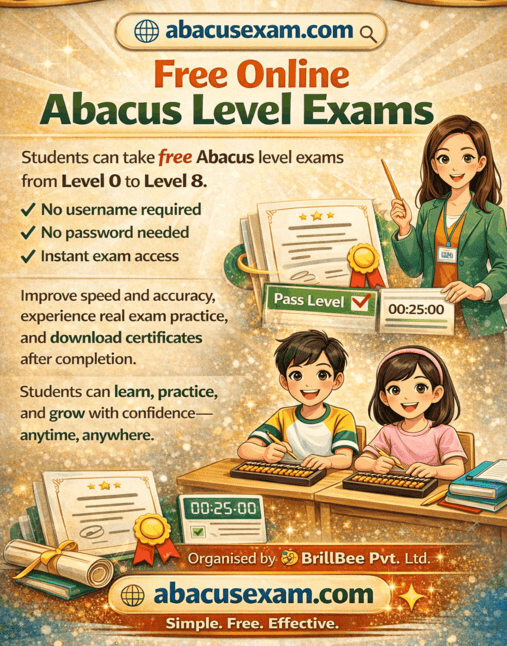
Students who want to improve their calculation speed and accuracy can also do regular practice. You can try abacus practice, abacus exams, and 1-minute mental math challenges here: Practice on Brillbee Academy
⚡ Why Olympiad Preparation Is Different
Regular abacus classes focus on gradual learning. Olympiads demand peak performance under time pressure. The question difficulty is higher, the time limit is tighter (e.g., 100 sums in 8 minutes), and there’s zero room for careless errors. Your child needs targeted speed drills, mock exams, and stress management training.
📋 Understanding the National Abacus Olympiad Format
Most national olympiads have two rounds: written (physical abacus) and mental (visualization). Categories: Addition/Subtraction, Multiplication, Division, and Mixed Operations. Time per section: 5-10 minutes. Negative marking for wrong answers in some exams. Levels: Beginner (grades 1-2), Intermediate (3-4), Advanced (5+).
📅 6-Month Olympiad Preparation Plan
Month 1-2: Master all formulas (small friend, big friend, combination). Daily 30 min practice. Month 3: Introduce timed section drills – 20 sums in 2 min. Month 4: Full-length mock tests weekly. Analyze errors. Month 5: Increase difficulty – past olympiad papers. Month 6: Simulate exam conditions (same time of day, strict timing). Last week: light practice, focus on mental visualization.
🌟 Success Story: Riya’s Journey to National Bronze
Riya (age 9) was an average abacus student. Her parents enrolled her in our olympiad prep program. We followed the 6-month plan: daily timed drills, weekend mock tests, and error analysis. Her speed improved from 40 sums in 5 min to 78 sums in 5 min. She secured 3rd place in the National Abacus Olympiad. The key? Consistency and mock test discipline.
✅ Benefits of Olympiad Participation (Beyond Medals)
- 🏅 Builds resilience – learning to perform under pressure.
- ⏱️ Skyrockets speed – regular classes can’t match olympiad intensity.
- 📈 Boosts school exam performance – timed tests feel easier.
- 🌍 Opens doors to international competitions.
- 🎓 Adds weight to academic portfolios for future admissions.
⚖️ Speed vs Accuracy – The Olympiad Balance
Many students rush and make mistakes. Olympiad winners know: accuracy first, then speed. A wrong answer is worse than a skipped one (if negative marking). Train your child to solve at 85% of their maximum speed – that sweet spot where errors are minimal. Use the “stopwatch plus error count” method: if errors exceed 5%, slow down next attempt.
⭐ Expert Tips by Ashwani Sharma
- 📌 Start mock tests 3 months before the exam – at least 8 full-length mocks.
- 📌 Use a digital timer with a loud beep – simulates exam pressure.
- 📌 Practice dictation (listening sums) – many olympiads have an audio round.
- 📌 Teach your child to skip difficult sums and return later.
- 📌 Ensure they get 8 hours of sleep before exam day – tiredness kills speed.
- 📌 On exam day, eat a light breakfast – avoid sugar crashes.
- 📌 Do a 5-minute warm-up (easy sums) right before entering the hall.
✅ Do’s and ❌ Don’ts for Olympiad Prep
Do’s: Do analyze every mock test error. Do practice with old question papers. Do encourage your child – avoid pressure. Do ensure the abacus is in perfect condition (smooth beads). Do arrive early on exam day.
Don’ts: Don’t introduce new formulas in the last month. Don’t compare scores with peers. Don’t skip mental visualization practice. Don’t over-practice the day before – rest is important. Don’t ignore handwriting – illegible numbers cost marks.
📈 Expected Outcomes from Olympiad Preparation
- ✨ 2-3x speed improvement compared to pre-prep levels.
- ✨ Ability to solve 100+ sums in 5 minutes (advanced category).
- ✨ Near-zero careless errors with consistent accuracy >95%.
- ✨ Confidence to compete at state/national level.
- ✨ Improved performance in school math tests (timed sections).
❌ Common Mistakes in Olympiad Prep
- 1. Starting preparation too late (less than 2 months before exam).
- 2. Only practicing easy sums – avoid difficult ones.
- 3. No mock tests under timed conditions.
- 4. Ignoring mental abacus (visualization) practice.
- 5. Parents adding stress instead of support.
- 6. Not checking the official syllabus – practicing wrong topics.
Download free olympiad practice papers and read our complete competition guide.
❓ FAQs About National Abacus Olympiad
Q1: What is the minimum age for participation?
A: Usually 6 years and above. Categories by grade.
Q2: How many questions are typically in the exam?
A: 80-120 questions, to be solved in 45-60 minutes total.
Q3: Is there negative marking?
A: Some olympiads have -0.25 for wrong answers; check the specific exam rules.
Q4: Can my child use a physical abacus for all sections?
A: Usually yes for the first round; mental abacus round prohibits physical tool.
Q5: How many months of abacus experience are needed?
A: At least 6-8 months of regular training before attempting olympiad.
Q6: Do you offer specific olympiad coaching?
A: Yes, I provide targeted olympiad prep modules. WhatsApp for details.
🚀 Turn Your Child into an Olympiad Medalist!
Join my olympiad-focused coaching program. Limited seats. Free assessment.
📞 Call/WhatsApp: +91 96641 11853📌 Summary: Plan, Practice, Perform
National Abacus Olympiad success is achievable with a structured 6-month plan, consistent mock tests, and the right mindset. Use this guide to prepare your child, and watch them shine on the national stage.