How Abacus Helps Children Enjoy Mathematics 🧮🎓
Welcome! I’m Ashwani Sharma. Over the years, working closely with children, parents, and teachers through Mission Abacus Private Limited in Jaipur, I’ve had countless conversations that start with a quiet concern: “My child doesn’t enjoy maths.”
That concern is universal. Whether the family is in India, the UK, the US, Canada, Australia, New Zealand, Czechia, the UAE, or Qatar, the emotion is the same. Maths has slowly become a subject children tolerate rather than enjoy. This is exactly where today’s topic matters—how Abacus helps children enjoy mathematics.
This blog is not about pushing a method. It’s about understanding children, learning behaviour, and how Abacus gently changes a child’s relationship with numbers. 📘
📑 Table of Contents
- Why So Many Children Stop Enjoying Mathematics
- How Abacus Helps Children Enjoy Mathematics at an Emotional Level
- Making Numbers Visual, Not Scary
- Learning Through Hands, Not Fear
- The Role of Confidence in Enjoying Maths
- Benefits for Children Who Fear Mathematics
- What Parents Start Noticing at Home
- How Teachers Experience the Change
- Practice, Exams, and Healthy Motivation
- Audio Practice and Mental Play 🎧
- Online Learning and Global Classrooms 🌍
- How Abacus Helps Children Enjoy Mathematics Over Time
- When Abacus May Not Be Enough
- A Gentle Reality Check for Adults
- A Reflective Question for Parents and Teachers
- Practical Tips to Keep Maths Enjoyable
- FAQs
- A Personal Closing Note
Why So Many Children Stop Enjoying Mathematics 💡
Children are not born disliking maths.
They learn to dislike it.
In my experience working with students and teachers, I’ve noticed that enjoyment disappears when maths becomes only about marks, speed, and correction. When mistakes are highlighted more than effort, curiosity fades.
Gradually, numbers stop feeling playful and start feeling heavy.
Understanding this emotional shift is the first step in seeing how Abacus helps children enjoy mathematics again.
How Abacus Helps Children Enjoy Mathematics at an Emotional Level 🧮
Before Abacus improves calculation, it improves comfort.
Children don’t begin with formulas.
They begin with beads, movement, and rhythm.
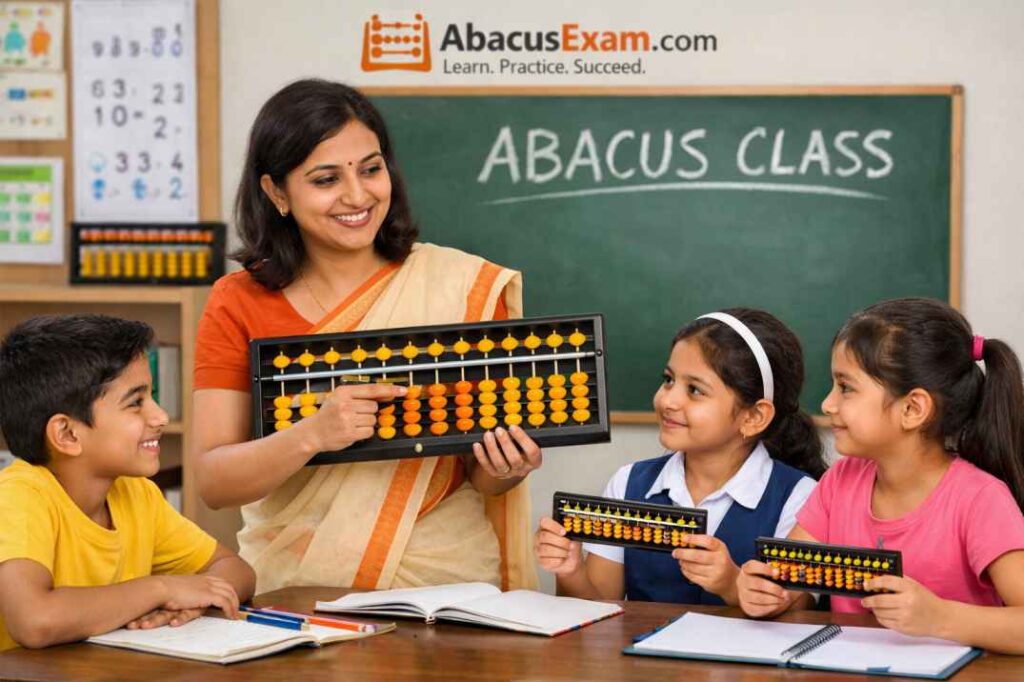
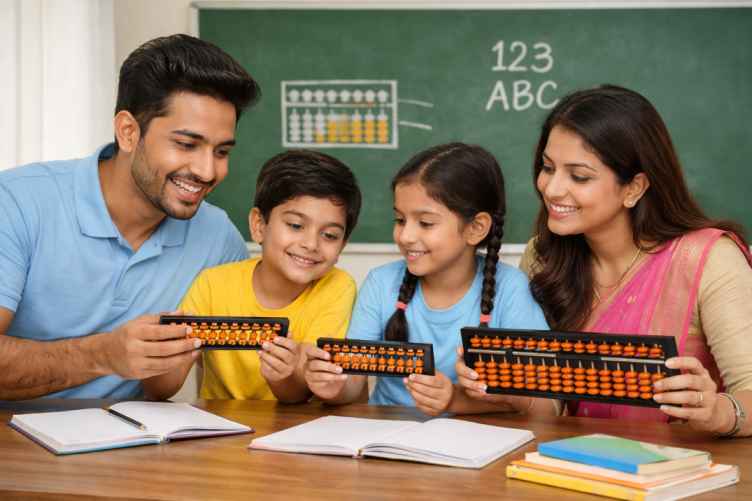
Abacus allows children to touch maths. Numbers are no longer abstract symbols on a page. They become something the child can move, see, and control.
Based on real classroom learning, this sense of control is what brings enjoyment back.
Making Numbers Visual, Not Scary 📘
Many children struggle because maths is taught only on paper.
Abacus changes that by making numbers visual. When children see quantity instead of memorising steps, understanding feels natural.
Over the years, I’ve noticed that visual learners respond especially well. They stop asking, “Why is this wrong?” and start asking, “Can I try again?”
That curiosity is a sign that maths is becoming enjoyable.
Learning Through Hands, Not Fear ✋
Children learn best when their hands are involved.
Abacus uses hand–brain coordination. This slows down anxiety and speeds up understanding. Instead of racing to an answer, children focus on the process.
Mistakes become part of play, not failure.
This simple shift explains a lot about how Abacus helps children enjoy mathematics.
The Role of Confidence in Enjoying Maths 🌱

Enjoyment grows when confidence grows.
Children who feel confident:
- Attempt questions willingly
- Stay calmer during tests
- Participate in class discussions
Abacus builds confidence quietly. There’s no pressure to outperform others. Progress is personal.
And when confidence rises, enjoyment follows naturally.
Benefits for Children Who Fear Mathematics 🚀
For children who feel anxious about maths, Abacus can help by:
- Reducing fear of numbers
- Improving concentration
- Encouraging independent thinking
- Making practice feel less tiring
Parents often say their child now tries before giving up. That effort is the real success.
What Parents Start Noticing at Home 👀
Parents usually notice emotional changes before academic ones.
They notice that:
- Homework time is calmer
- Children explain answers confidently
- Maths-related arguments reduce
Over the years, I’ve noticed that when a child enjoys maths, practice becomes voluntary. And voluntary practice is far more powerful than forced study.
This is a key part of how Abacus helps children enjoy mathematics at home.
How Teachers Experience the Change 🎓
Teachers often tell me that Abacus-trained children:
- Pay better attention
- Attempt mental calculations willingly
- Show patience during problem-solving
Abacus does not replace classroom teaching. It supports it by strengthening the child’s comfort with numbers.
That support allows teachers to teach concepts more effectively.
Practice, Exams, and Healthy Motivation 📊
Enjoyment doesn’t mean avoiding structure.
Balanced practice matters.
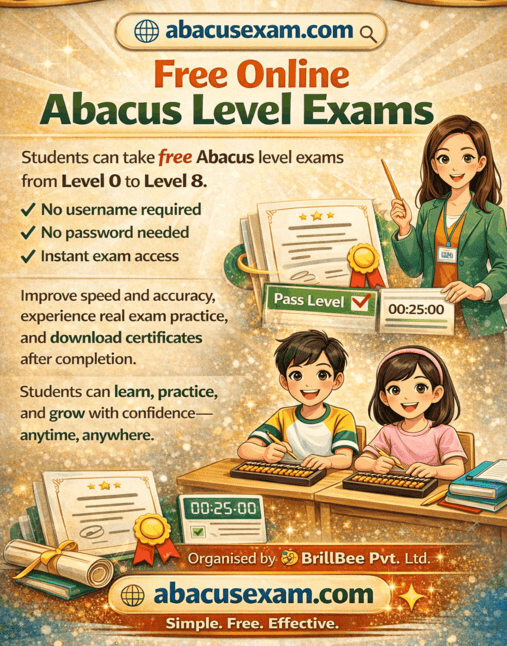
Platforms like the Abacus Level Exam Platform – https://abacusexam.com help children track progress without fear. Exams here are milestones, not judgments.
For children who feel nervous about time pressure, understanding how to manage abacus exam duration calmly and effectively can be very helpful:
https://abacusexam.com/abacus-exam-duration-time-management-tips/
Students who practice regularly, appear for level exams, and participate in competitions show faster improvement in speed, accuracy, and confidence.
Audio Practice and Mental Play 🎧
Enjoyment also comes from variety.
Audio-based Abacus practice turns maths into listening and imagination. Children visualise numbers instead of staring at screens.
The Abacus Audio Practice & 100-Level Challenge – https://abacuswala.com supports this mental play.
When children later participate in friendly challenges through the Abacus Competition Platform – https://abacusshiksha.com, they experience excitement without fear.
Together, these tools form an All-in-One Abacus Learning System that keeps learning engaging.
Online Learning and Global Classrooms 🌍
Online education has changed how children learn.
Across countries, children now face:
- Screen fatigue
- Short attention spans
- Reduced hands-on activity
Abacus adapts well to online learning because it keeps the child active. Hands move. Minds engage.
This makes Abacus relevant for children worldwide, regardless of education system.
How Abacus Helps Children Enjoy Mathematics Over Time 🧠
Enjoyment deepens with consistency.
Abacus helps children develop:
- A positive maths identity
- Mental flexibility
- Patience with problem-solving
Children who enjoy maths early are more open to advanced concepts later. This long-term comfort matters more than short-term speed.
That’s the deeper answer to how Abacus helps children enjoy mathematics.
When Abacus May Not Be Enough ⚖️
It’s important to be honest.
Abacus may not help if:
- A child is forced into it
- Practice becomes punishment
- Expectations are unrealistic
Abacus supports enjoyment, but it cannot replace emotional support, good teaching, or understanding learning difficulties when they exist.
Balance is essential.
A Gentle Reality Check for Adults 💭
Sometimes, the pressure comes from us.
Children often dislike maths not because of numbers, but because of expectations. When adults slow down and listen, children respond.
Understanding how Abacus helps children enjoy mathematics also means understanding when to step back.
A Reflective Question for Parents and Teachers ✨
When your child learns maths, do they feel safe to make mistakes?
The answer to that question often determines whether enjoyment can return.
Practical Tips to Keep Maths Enjoyable 📘
To support enjoyment alongside Abacus:
- Keep sessions short
- Praise effort, not speed
- Avoid comparison
- Allow mistakes
Teachers who wish to understand this approach more deeply often explore free Abacus teacher training, which focuses on child psychology and learning behaviour rather than performance pressure. Mission Abacus Private Limited encourages this mindset-based learning.
❓ Frequently Asked Questions (FAQs)
Can Abacus help children who hate maths?
Yes. Abacus often reduces fear by making maths visual and hands-on.
Is Abacus suitable for very young children?
Yes, when taught playfully and without pressure.
How long does it take for children to enjoy maths again?
Many children show emotional improvement within a few months of regular practice.
Does Abacus help with school maths?
Yes. It supports calculation confidence, which helps in school learning. You can also explore how Abacus supports school mathematics learning here:
https://abacusexam.com/can-abacus-help-in-school-maths/
Is online Abacus effective for children?
Yes, especially when sessions remain interactive and balanced.
Is Abacus only about speed?
No. Its biggest benefit is confidence and enjoyment, not just speed.
A Personal Closing Note 🌱
After years of working with children, I’ve learned that enjoyment is the foundation of learning. When children enjoy maths, improvement follows naturally.
Abacus doesn’t force that enjoyment. It invites it—gently, patiently, and respectfully.
And when a child smiles while solving a maths problem, you know something meaningful has changed. 🧮✨
— Ashwani Sharma