🧮 What Is Abacus Education and Why Is It Still Relevant in 2027?
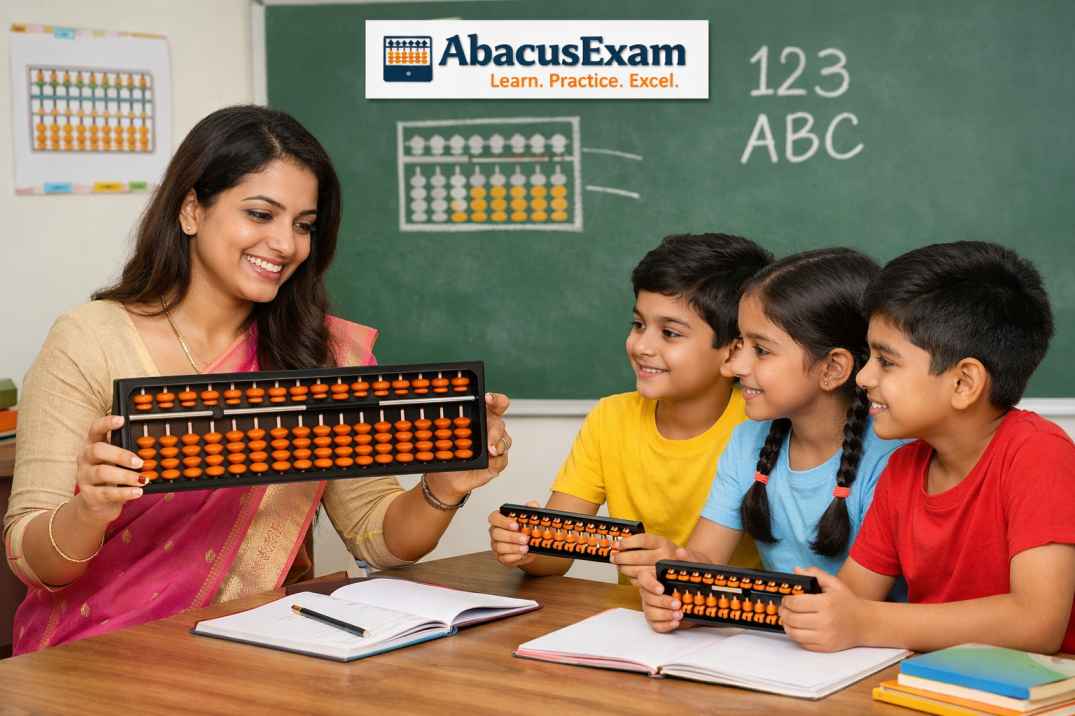
Students develop focus and mental calculation skills through structured abacus practice
🤔 Have you ever wondered if abacus still makes sense when every kid has a calculator on their phone?
Most parents assume abacus is outdated. But the real problem isn’t the tool — it’s that children are losing the ability to focus and think without a screen.
In this comprehensive guide, I’ll show you exactly what abacus education is, why it’s more relevant in 2027 than ever, and how it rewires your child’s brain for lifelong success.
📖 What Is Abacus Education? (It’s Not Just Counting Beads)
Abacus education is a structured method that uses a physical abacus to teach arithmetic. Children slide beads up and down. But the real magic happens inside their brain.
After a few months, they learn to visualise the abacus. They solve sums mentally — without touching the tool. That’s called mental math. And it’s the gateway to faster thinking.

I’ve seen 7-year-olds who couldn’t add 5+3 without using their fingers. After 3 months of abacus education, they solve two-digit sums in seconds. Mentally. Without stress.
Here’s what most people miss: abacus trains both hemispheres of the brain. The left handles logic and numbers. The right handles visualization and memory. Together, they build a sharper, faster mind.
📅 Why Is Abacus Education Still Relevant in 2027?
You might be thinking: “We have AI, calculators, and smartphones. Why learn abacus?” I get this question almost every week.
Here’s the truth: calculators give answers. Abacus builds the ability to think. In 2027, children face more distractions than ever. Their attention spans are shrinking. Social media, reels, and games train the brain to seek quick dopamine — not deep focus.
Abacus forces the opposite. No notifications. No autofill. Just the child’s mind and the beads. That kind of concentration is rare today — and that’s exactly why it’s valuable.
🧠 The Neuroscience Reason (H3 with keyword)
Studies show that abacus training increases gray matter in the brain’s parietal lobe — the area responsible for spatial reasoning and attention. Even after stopping practice, the benefits remain. That’s neuroplasticity in action.
I always tell parents: “Your child will never need an abacus in an exam. But the brain wiring it creates will help them forever — in maths, science, and even life decisions.”
✨ 7 Science-Backed Benefits of Abacus Education
In 10+ years of training, I’ve documented these benefits repeatedly. They’re not theories — they’re everyday results.
1. Lightning-fast mental math
Within 6 months, students solve 50+ addition problems mentally — faster than typing on a calculator. Their confidence soars.
2. Improved concentration
Parents tell me: “My child can now sit and study for 30 minutes without checking the phone.” That’s rare in 2027.
3. Better memory retention
Abacus strengthens working memory. Kids remember spellings, formulas, and even historical dates more easily.
4. Reduced maths anxiety
I once had a student, Arjun from Jaipur, who cried before every maths test. After 4 months of abacus, he started solving sums for fun. That’s the real win.
5. Faster problem-solving
Abacus trains the brain to break down problems into smaller steps. This skill transfers to science, coding, and even daily challenges.
6. Enhanced listening skills
In abacus classes, children listen to numbers and calculate mentally. This improves their ability to follow instructions in school.
7. Long-term cognitive reserve
Research suggests early abacus training may protect against age-related cognitive decline. It’s an investment in lifelong brain health.
🏠 How to Practice Abacus Education at Home (Step-by-Step)
Consistent home practice is the secret to rapid progress. Here’s exactly what works.
Daily Practice Routine for Abacus Students
Set aside 15-20 minutes every day, preferably before school or after dinner. Use a timer. No distractions.
- Step 1 (2 mins): Finger warm-up — move beads up and down on all rods.
- Step 2 (10 mins): Solve 20-30 sums on the physical abacus (addition, subtraction, or multiplication based on level).
- Step 3 (5 mins): Mental math without the abacus — visualise and solve 10 sums.
- Step 4 (3 mins): Review mistakes. Correct them immediately.
Level-Wise Exam Practice Tips
What to Expect at Each Level Exam
| Level | Skills Tested | Practice Tip |
|---|---|---|
| Basic (Level 1-2) | Addition/subtraction (1-2 digits) | Practice 30 sums daily on physical abacus |
| Intermediate (Level 3-4) | 3-digit sums, multiplication intro | Focus on visualisation — close eyes and “see” beads |
| Advanced (Level 5-6) | Multiplication, division, decimals | Mix mental and physical; time each set |
| Expert (Level 7-8) | Complex mental math with 5+ digits | Simulate exam conditions — no abacus, only mind |
Mental Math Practice Techniques
These techniques have worked for thousands of my students:
- The “Eyes Closed” Method: After solving on the abacus, close your eyes and re-solve the same sums mentally. Do this for 5 sums daily.
- The Speed Challenge: Set a 60-second timer. How many single-digit sums can you do mentally? Increase difficulty weekly.
- The Real-Life Addition: At the grocery store, ask your child to add prices mentally. Make it a game.
Mental Math Practice for Different Ages
Ages 4-7: Focus on single-digit sums, use colorful beads, keep sessions under 10 minutes.
Ages 8-12: Two- and three-digit sums, introduce multiplication, increase to 20 minutes.
Ages 12+: Decimals, fractions, and speed drills — aim for 30 sums in 2 minutes.
🎓 Also Explore
Level-Wise Abacus Practice at BrilBee Academy
Structured courses, mock exams, and certified trainers for kids aged 4-14. Perfect for exam preparation and skill mastery.
🌐 Visit BrilBee Academy →👨🏫 Expert Tips from 10+ Years of Abacus Training
Over the years, I’ve discovered what truly works. Here are my top 5 tips for parents and students.
💡 Tip 1: Start between ages 5 and 7
I always tell parents — this is the golden window. The brain is most plastic. Kids pick up visualisation naturally. Older children can still learn, but it takes more effort.
💡 Tip 2: Consistency beats intensity
15 minutes every day is better than 2 hours once a week. Make it a habit. Attach it to something fixed — like after brushing teeth.
💡 Tip 3: Don’t skip the physical abacus
Even for mental math, beginners need to touch the beads. The muscle memory helps build the visual image. Only move to pure mental practice after 3-4 months.
💡 Tip 4: Celebrate small wins
Finished 10 sums without error? Clap. Did a mental sum in 5 seconds? High-five. Positive reinforcement works wonders.
💡 Tip 5: Be patient with plateaus
Every child hits a plateau around Level 3. Don’t panic. Just reduce difficulty slightly and rebuild confidence. They’ll break through in 2-3 weeks.
⚠️ 5 Common Mistakes Parents Make (And How to Fix Them)
1. Skipping visualisation practice
Many kids only practice on the physical abacus. That’s like learning to swim but never leaving the shallow end. Fix: After each session, ask them to close their eyes and “see” the beads moving.
2. Moving levels too fast
Parents want quick results. But rushing creates gaps. Fix: Ensure your child can solve 90% of sums correctly at a level before moving up.
3. No daily routine
Irregular practice leads to frustration. Fix: Set a fixed time. Use a habit tracker. Reward streaks.
4. Focusing only on speed
Speed comes naturally after accuracy. Fix: First week of a new level, ignore timing. Focus on correctness. Then add speed gradually.
5. Not communicating with the teacher
I’ve seen parents assume everything is fine. Then after 6 months, no progress. Fix: Ask your teacher every month: “What specific skill should we practice at home?”
✅❌ Do’s and Don’ts of Abacus Learning
✅ Do’s
- Practice at the same time every day
- Use a quiet, distraction-free space
- Praise effort, not just correct answers
- Review mistakes together calmly
- Incorporate mental math into real life (bills, grocery)
- Ensure proper posture — sit upright, abacus at chest level
❌ Don’ts
- Don’t compare your child to siblings or friends
- Don’t force extra practice when tired or upset
- Don’t rush to mental math too early
- Don’t ignore finger technique — it matters
- Don’t expect overnight miracles; give it 3 months
- Don’t skip the listening exercises (teacher reads numbers aloud)
📊 Real Results: Before vs After Abacus Training (6 Months)
| Skill | Before Abacus | After 6 Months |
|---|---|---|
| Mental addition (2-digit) | 10 seconds, often wrong | 3 seconds, 95% accuracy |
| Concentration span | 5-7 minutes | 20+ minutes |
| Maths test confidence | Anxious, avoids sums | Eager, finishes first |
| Memory (digit span) | Remembers 5 digits | Remembers 8-10 digits |
| Homework time | 45 minutes for maths | 20 minutes |
💬 A Real Story from My Classroom
I once had a student named Priya, 8 years old from Jaipur. She used to hide her maths notebook. Her mother told me, “She cries every night before exams.” In our first class, she wouldn’t even touch the abacus. I started with just moving beads — no sums. After 2 weeks, she smiled when she got a sum right. After 3 months, she solved 20 sums in 2 minutes. Her mother called me crying — happy tears. Today, Priya is in 6th grade and helps her younger brother with maths. That’s the real power of abacus education.
💬 What Parents and Students Say
“My son Aryan (9) had zero interest in maths. After 5 months of abacus training with Mission Abacus, he voluntarily solves extra sums. His teacher noticed the change too — more participation in class.”
– Sneha Mehta, Mother (Mumbai)“I’m a teacher myself. I enrolled my daughter because I saw how abacus improved my students’ focus. Within 4 months, her reading comprehension also improved — something I didn’t expect.”
– Rajesh Nair, Father & School Teacher (Bangalore)“I used to be slow in maths. Now I can do 3-digit sums in my head faster than my friends use calculators. Abacus made me love numbers.”
– Ananya S., 11 years old, Student💪 Ready to see the difference in your child? A free demo class takes just 30 minutes.
🎯 Book Your Free Demo →❓ Frequently Asked Questions About Abacus Education
What is the ideal age to start abacus education?
5 to 12 years is the sweet spot. The brain is highly plastic during these years. That said, teenagers and even adults can benefit, though visualisation takes longer to develop.
How long before I see results in my child?
Most parents notice better concentration within 2 months. Mental math speed improves by month 3-4. For full brain development and exam-level fluency, 12-18 months of regular practice is ideal.
Can abacus help with school exams like Olympiads?
Absolutely. Many of our students crack maths Olympiads because abacus improves speed and accuracy. They finish calculation-heavy sections faster, leaving more time for reasoning problems.
Is online abacus as effective as in-person?
Yes, when taught live with proper interaction. We’ve trained 1000+ kids online. The key is a good instructor, a physical abacus kit at home, and daily practice. Live video allows us to correct finger movements in real time.
Does abacus work for children with learning difficulties?
I get asked this a lot. Abacus has shown positive results for children with dyscalculia and ADHD. The tactile, visual, and kinesthetic nature helps them grasp numbers. However, always consult a specialist first.
What’s the difference between abacus and Vedic maths?
Abacus is a tool that builds visualisation and mental math step by step. Vedic maths is a set of mental shortcuts. Abacus is better for younger children (ages 5-10) because it’s concrete. Vedic maths works well for older kids (10+). Many students do both.
How much does abacus training cost?
Fees vary by location and format. In India, group classes range from ₹1,000 to ₹2,500 per month. Online courses can be more affordable. We offer a 2-week trial at nominal cost. WhatsApp us for exact pricing and scholarships.
Can parents learn abacus to teach their own child?
Yes, we offer parent training sessions. But I recommend professional guidance for the first 3-4 months. Parents often miss small technique errors that become hard to correct later. After that, you can supervise practice effectively.
💛 Your child’s best years are right now. Don’t let digital distractions steal their ability to focus and think deeply.
I’m Ashwani Sharma. I’ve helped over 5000 children transform their maths skills and confidence. Let me help yours too.
📲 Start Your Child’s Journey Today →