Can Adults Learn Abacus for Brain Exercise and Cognitive Health?
Honest review: Benefits, real experiences, challenges, and practical tips for grown-ups
Quickly jump to any section 👇
Introduction
In today’s busy world, many adults worry about memory decline, lack of focus, and keeping their brain sharp. While kids learn abacus in schools, a growing number of adults are asking: Can adults learn abacus for brain exercise and cognitive health?
The surprising answer is yes! Adults can successfully learn abacus and gain powerful brain benefits. After 10+ years of teaching, I’ve helped many working professionals, homemakers, and seniors improve their mental agility through abacus training.
Problem Understanding
With age, many adults notice slower thinking, forgetfulness, difficulty multitasking, or reduced mental stamina. Long working hours, screen time, and stress further weaken cognitive abilities. Traditional brain exercises like puzzles or apps often become repetitive and boring.
Adults need a challenging yet engaging activity that trains multiple brain functions at once — and abacus does exactly that.
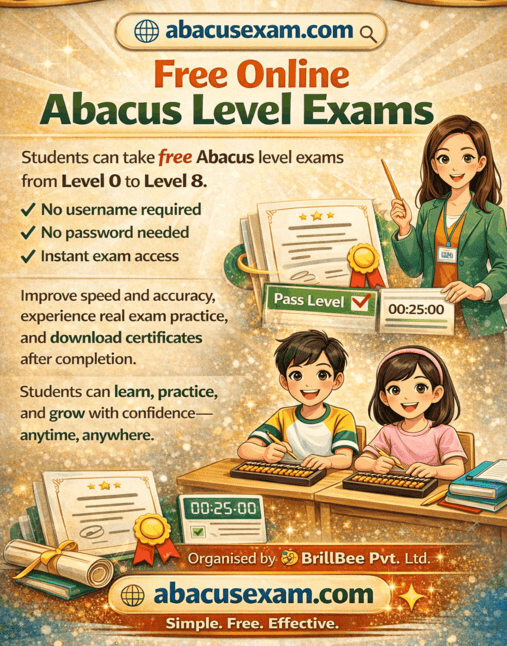
Students who want to improve their calculation speed and accuracy can also do regular practice.
You can try abacus practice, abacus exams, and 1-minute mental math challenges here:
Practice on Brillbee Academy
Main Concept
Abacus training for adults involves learning to manipulate beads with both hands while visualizing calculations mentally. This dual-hand movement combined with mental imagery creates a powerful full-brain workout. It activates logical thinking (left brain) and visualization + creativity (right brain), making it one of the best exercises for cognitive health.
Step-by-Step Method for Adults
Adults learn abacus differently from children. Here’s a practical adult-friendly approach:
- Week 1-2: Understand the abacus tool and basic finger movements (both hands).
- Week 3-6: Master addition and subtraction with physical abacus.
- Month 2-3: Start mental visualization and faster calculations.
- Month 4+: Advance to multiplication, division, and complex problems.
- Ongoing: Daily 15–20 minute practice integrated into routine.
Real Adult Success Stories
A 34-year-old software engineer from Jaipur started abacus to fight brain fog from long coding hours. After 4 months, he reported sharper focus during meetings and faster mental math while working with numbers.
A 48-year-old homemaker learned abacus for cognitive health. She now calculates grocery bills mentally in seconds and feels more confident handling daily finances.
One 62-year-old retired teacher joined for memory improvement. He proudly says his grandchildren now ask him for quick calculations!
Benefits for Brain Exercise & Cognitive Health
- Improves working memory and long-term recall
- Enhances concentration and mental stamina
- Boosts processing speed and mental agility
- Strengthens both brain hemispheres simultaneously
- Reduces risk of cognitive decline with regular practice
- Increases overall brain plasticity even in adulthood
- Provides stress relief through focused, meditative practice
Detailed Explanation
Learning abacus as an adult is a form of neurobics — exercises that challenge the brain in new ways. The finger movements create new neural connections, while mental visualization improves the brain’s ability to manipulate information quickly.
Research on mental calculation tools shows improvements in executive function, attention, and numerical processing. For adults, even 15 minutes daily can deliver noticeable benefits in focus and mental clarity within 8–12 weeks.
Unlike passive activities like watching videos, abacus demands active engagement, making it highly effective for maintaining cognitive health as we age.
⭐ Expert Tips by Ashwani Sharma
- Start with 10–15 minutes daily instead of long sessions.
- Use both hands from the beginning for maximum brain activation.
- Integrate practice into your routine — morning or evening commute time works well.
- Track your progress with timed challenges to stay motivated.
- Combine abacus with walking or light exercise for better results.
- Don’t aim for perfection initially — focus on consistency.
- Join a small adult batch or online sessions for guidance.
✅ Do’s and ❌ Don’ts for Adults Learning Abacus
✅ Do’s
- Practice consistently even if for short durations
- Be patient with yourself — adults learn at their own pace
- Use real-life applications like calculating bills mentally
- Keep a progress journal
- Enjoy the process rather than competing
❌ Don’ts
- Don’t compare your speed with children
- Don’t skip practice for weeks
- Don’t get frustrated with initial slow progress
- Don’t practice when very tired or stressed
- Don’t expect child-level speed immediately
📈 Expected Results
- Noticeable improvement in mental calculation speed within 6–8 weeks
- Better focus and reduced mental fatigue during work
- Stronger memory for numbers and daily tasks
- Increased confidence in handling calculations
- Overall feeling of mental sharpness
- Long-term protection against cognitive decline
❌ Common Mistakes Adults Make
- Expecting fast results like children
- Practicing irregularly due to busy schedules
- Focusing too much on speed instead of technique
- Giving up after the initial learning curve
- Not using both hands properly
- Treating it only as a calculation tool instead of brain exercise
FAQs
Q1. Is it too late for adults to learn abacus?
No. Adults of any age (25 to 65+) can learn and benefit greatly.
Q2. How much time should adults practice daily?
15–20 minutes daily is enough to see good cognitive benefits.
Q3. Can abacus prevent memory loss?
Regular practice supports brain health and may help delay age-related cognitive decline.
Q4. Do I need a physical abacus or can I learn online?
Both work. A physical abacus is better in the beginning, then you can move to mental practice.
Q5. Will it help with my job that involves numbers?
Yes. Many professionals report faster and more accurate calculations at work.
Summary
Yes, adults can definitely learn abacus for brain exercise and cognitive health. It offers a unique, engaging way to keep your mind sharp, improve memory, boost concentration, and maintain mental agility. With consistent short practice, adults of all ages can enjoy significant cognitive benefits.
If you want to give your brain a powerful workout, abacus training is an excellent choice.
🚀 Keep Your Brain Sharp at Any Age!
Start Abacus Training Today
📞 Call / WhatsApp: +91 96641 11853
Ashwani Sharma – Abacus & Mental Math Trainer, Jaipur
Ashwani Sharma is an Abacus Trainer & Mental Math Educator based in Jaipur with over 10 years of experience. He specializes in Abacus Training, Mental Math, Brain Development, and Vedic Maths.
Watch free lessons:
English YouTube Playlist | Hindi YouTube Playlist
Training ke liye WhatsApp/Call: +91 96641 11853