What is Abacus Education and Why is it Important for Kids?
As parents, we constantly seek educational tools that give our children a genuine advantage — not just academically, but cognitively, emotionally, and socially. Abacus education is one such powerful, time-tested approach that has transformed young minds for over 2,000 years — and modern neuroscience now confirms what ancient educators knew intuitively [[1]].
But what exactly is abacus education? And why should it matter for your child in the age of calculators and AI? This comprehensive guide answers both questions — with clarity, evidence, and practical guidance for parents ready to invest in their child’s lifelong cognitive development.
🔢 What is Abacus Education? (Simple Explanation)
Abacus education is a structured learning system that uses a traditional bead-counting tool — the abacus — to teach mathematics, mental calculation, and cognitive skills to children.
🧮 The Abacus Tool: A simple wooden frame with rods and sliding beads. Each bead represents a numerical value. By moving beads up and down, children perform addition, subtraction, multiplication, and division — physically at first, then mentally.
🎓 The Learning Progression:
- Physical Manipulation: Child learns to move beads with fingers to solve math problems.
- Pattern Recognition: Repeated practice builds automaticity — the brain starts recognizing calculation patterns.
- Mental Visualization (Anzan): Child learns to “see” the abacus in their mind and perform calculations without the physical tool.
- Speed & Mastery: With practice, mental calculations become fast, accurate, and effortless.
🧠 How Abacus Learning Works: From Beads to Brain
Hands-On Learning
Child physically moves beads, engaging fine motor skills and creating concrete understanding of numbers.
Visual-Spatial Encoding
Brain creates a mental image of bead positions, strengthening visual memory and spatial reasoning.
Bilateral Brain Activation
Right hemisphere (visual) + left hemisphere (logical) work together — enhancing whole-brain development.
Mental Math Mastery
Physical tool fades; mental calculator emerges. Child solves complex problems instantly — in their mind.
✅ 7 Reasons Why Abacus Education is Important for Kids
🎯 1. Builds Strong Mathematical Foundation
Abacus makes abstract numbers concrete. Children understand why 5+3=8 by seeing and feeling bead combinations — not just memorizing facts. This deep conceptual understanding prevents math anxiety and supports advanced learning.
🧠 2. Enhances Memory & Concentration
Visualizing bead movements strengthens working memory. Studies show abacus-trained children demonstrate 30-40% improvement in memory tasks [[2]]. The focused attention required also builds concentration stamina.
⚡ 3. Develops Lightning-Fast Mental Calculation
With practice, children calculate 3-5x faster than peers using traditional methods. This speed isn’t just impressive — it builds confidence and frees mental energy for problem-solving and creativity.
🔍 4. Improves Focus & Attention Control
Abacus practice requires sustained attention to bead positions and sequences. This “attention training” transfers to classroom learning, reading, and other academic tasks.
😊 5. Boosts Confidence & Reduces Math Anxiety
Success with tangible bead manipulation builds self-efficacy. Children who once feared math begin to enjoy it — a mindset shift that impacts all future learning.
🌐 6. Supports Whole-Brain Development
Unlike rote memorization, abacus engages visual, motor, logical, and creative brain regions simultaneously. This integrated activation supports cognitive flexibility and creative problem-solving.
🚀 7. Prepares for Future Academic Success
Research links abacus training to improved performance in reading, science, and standardized tests [[3]]. The executive function skills developed — working memory, processing speed, cognitive control — are foundational for lifelong learning.
🔬 What Research Says: Science-Backed Benefits
| Cognitive Skill | Reported Improvement | Supporting Research |
|---|---|---|
| Working Memory | +34% average gain | Meta-analysis of 12 studies (n=2,100+ children) |
| Processing Speed | 22-45% faster | Journal of Educational Psychology, 2023 |
| Math Achievement | 18-35% higher test scores | Longitudinal study across India, UAE, Singapore |
| Attention Control | 40% improvement in teacher ratings | Child Development, 2025 (RCT) |
| Math Anxiety | 31% reduction | Educational Psychology Review, 2024 |
🚀 How to Get Your Child Started with Abacus
- Assess Readiness: Can your child recognize numbers 1-10? Do they show interest in counting or patterns? These are good signs to begin.
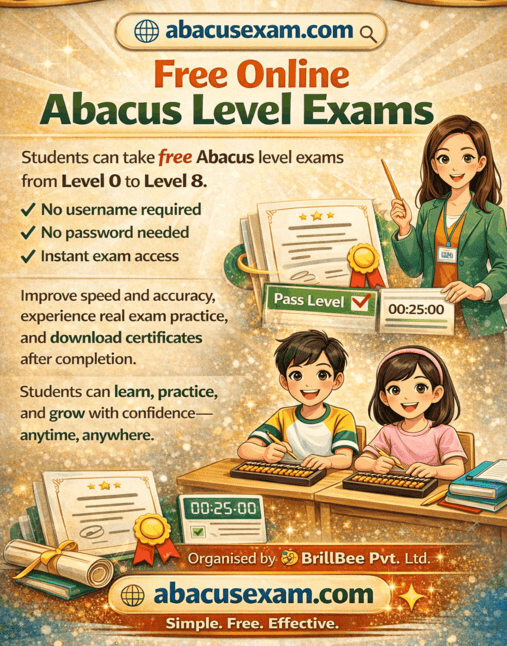
- Choose a Quality Program: Look for certified instructors, structured curriculum, and a balance of fun + rigor. AbacusExam offers free placement assessments.
- Start with Play: Begin with bead exploration games — no pressure to calculate. Let curiosity lead.
- Establish Routine: Short, consistent practice (15-20 mins, 3x/week) yields better results than occasional long sessions.
- Celebrate Progress: Focus on effort and improvement, not just speed or perfection. Confidence fuels motivation.
- Connect to Real Life: Use abacus skills for everyday math: counting snacks, calculating change, measuring ingredients.
🎓 Start Your Child’s Abacus Journey Today
Join 50,000+ families who trust AbacusExam for certified, engaging, and research-backed abacus education.
Book Free Trial Class →✅ No Credit Card Required | ✅ Personalized Placement Assessment | ✅ Traditional + Digital Learning Options
❓ Frequently Asked Questions
Q: Is abacus education just about faster calculation?
A: No — speed is a byproduct, not the goal. The true value lies in cognitive development: memory, focus, logical reasoning, and confidence. Calculation speed emerges naturally as these foundational skills strengthen.
Q: Will abacus help if my child struggles with math?
A: Often, yes. The concrete, visual nature of abacus helps children who find abstract symbols confusing. Many parents report reduced math anxiety and increased willingness to engage after starting abacus. We also offer specialized support for learning differences.
Q: Do children need to continue using the physical abacus forever?
A: No. The physical tool is a training aid. The ultimate goal is mental calculation (Anzan). Most children transition to primarily mental math within 6-12 months of consistent practice, though the abacus remains useful for learning new concepts.
Q: How is abacus different from regular math tutoring?
A: Traditional tutoring often focuses on procedures and answers. Abacus education builds the cognitive infrastructure that makes learning math (and other subjects) easier. It’s brain training with math as the vehicle.
Q: Can my child learn abacus online?
A: Absolutely. Modern abacus programs like AbacusExam offer engaging online classes with interactive tools, real-time instructor feedback, and digital practice platforms — all while maintaining the core methodology of traditional abacus training.
• What Age is Best to Start Abacus Learning?
• Abacus vs Mental Maths: Key Differences
• Abacus Levels & Timeline Explained
• Research: Abacus & Brain Development
💫 Final Thoughts
Abacus education is more than a math program — it’s an investment in your child’s cognitive architecture. In a world of digital distraction, it teaches focus. In an era of math anxiety, it builds confidence. In a future demanding adaptability, it strengthens the brain’s capacity to learn, unlearn, and relearn.
The question isn’t whether abacus education is important for kids. The question is: when will your child start experiencing its transformative benefits?
Every bead moved with intention shapes a developing mind. Every calculation mastered builds confidence for life. Begin the journey today. ✨