What Future Careers Benefit Most from Early Abacus Education?
Give your child skills that open doors to high-demand, high-reward careers in tomorrow’s world
Imagine your child at age 25, confidently working in a fast-paced, high-paying job — solving complex problems quickly, staying focused under pressure, and making smart decisions with numbers. Many parents in Jaipur wonder if early abacus training can actually help their child reach such future success.
The answer is a strong yes. Early abacus education builds powerful cognitive skills like mental math speed, sharp concentration, logical thinking, and strong memory. These are exactly the abilities that top future careers demand in our fast-changing world.
Quickly jump to any section 👇
Introduction
Today’s children will grow up in a world driven by technology, data, and quick decisions. Careers in STEM (Science, Technology, Engineering, Math), finance, and data fields are growing fastest. Early abacus training gives kids a hidden advantage by training their brain for speed, accuracy, and clear thinking.
As an abacus trainer with 10+ years of experience in Jaipur, I have watched hundreds of children develop skills that go far beyond school math. These skills prepare them for exciting future careers where mental sharpness matters more than ever.
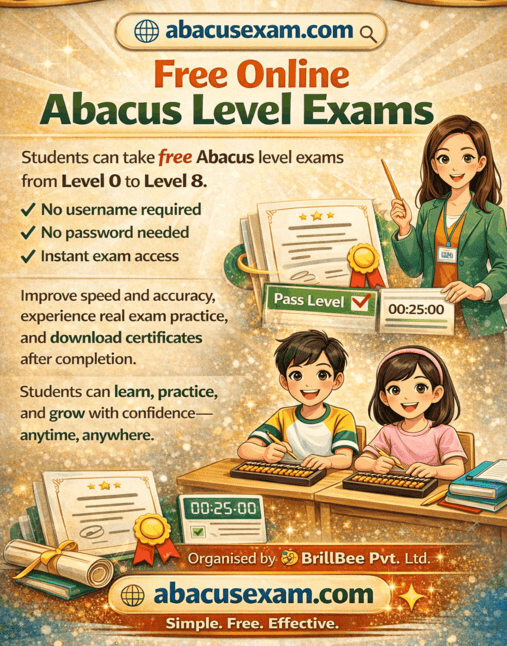
Students who want to improve their calculation speed and accuracy can also do regular practice.
You can try abacus practice, abacus exams, and 1-minute mental math challenges here:
Practice on Brillbee Academy
Problem Understanding
Many parents focus only on school grades, but the real challenge is preparing children for future jobs that don’t even exist yet. Traditional math teaching often leaves kids slow with calculations and weak in focus under pressure.
Without strong mental math and cognitive skills, children may struggle in competitive exams, higher studies, and fast-paced careers. Early abacus education solves this by building a strong brain foundation from a young age.
Main Concept
Abacus training teaches children to calculate mentally using visualization. This strengthens working memory, concentration, logical reasoning, and number sense — core skills for many high-growth careers.
These abilities transfer to real-world jobs where quick thinking, data handling, and problem-solving are essential. Starting early (ages 6–12) gives the brain more time to develop these strengths permanently.
Step-by-Step Method: How Abacus Prepares for Future Careers
- Build strong number sense — Understand numbers deeply through bead visualization.
- Develop mental calculation speed — Solve problems quickly without tools.
- Improve concentration and memory — Hold and manipulate information in the mind.
- Enhance logical thinking — Break down complex problems step by step.
- Apply skills to advanced topics — Move smoothly into algebra, statistics, and coding concepts.
- Gain confidence for real-world challenges — Stay calm and accurate under time pressure.
Real-Life Examples
Take 12-year-old Aarav from Jaipur. After two years of abacus, he calculates faster than most adults. Now in class 8, he loves science projects and wants to become a data scientist or AI engineer. His mental math skills help him analyze patterns quickly.
Another student, 10-year-old Meera, struggled with math anxiety. Abacus training improved her speed and confidence. She now dreams of becoming a financial analyst or actuary — careers where quick calculations and risk assessment are key.
Careers That Benefit Most from Early Abacus
| Career Field | Key Skills from Abacus | Why It Helps |
|---|---|---|
| Data Science / AI | Fast calculations, pattern recognition, memory | Quick data analysis and modeling |
| Engineering (Civil, Mechanical, Software) | Logical thinking, spatial skills | Problem-solving and design accuracy |
| Finance / Actuary | Mental math speed, accuracy under pressure | Risk calculation and financial modeling |
| Statistics / Analytics | Number sense, concentration | Interpreting large data sets |
| Architecture / Design | Visualization, measurement skills | Precise planning and creativity |
Benefits of Early Abacus Education for Future Careers
- Strong foundation for STEM subjects and competitive exams
- Better problem-solving and logical reasoning
- Improved focus and working memory for complex tasks
- Higher confidence in math-related decisions
- Advantage in data-driven and technology careers
- Long-term brain development that supports lifelong learning
Detailed Explanation: Why Abacus Skills Matter for Tomorrow’s Jobs
Future careers will rely heavily on technology, artificial intelligence, big data, and quick decision-making. Abacus training activates both sides of the brain — logical left and visual right — creating balanced cognitive power.
Skills like mental math help in fields such as engineering (calculating forces and designs), finance (risk analysis), and data science (handling numbers instantly). Visualization from abacus also supports coding, architecture, and scientific research.
Internal link: Children who build basics early perform better in our beginner abacus course in Jaipur. For advanced mental math techniques, explore mental math tips for kids.
⭐ Expert Tips by Ashwani Sharma
- Start abacus training between ages 6–12 for maximum brain benefits.
- Keep daily practice short (15–20 minutes) and consistent.
- Combine abacus with school math to see real connections.
- Encourage application in daily life — like calculating bills or scores.
- Focus on both speed and accuracy for long-term career readiness.
- Monitor progress and celebrate improvements to build confidence.
- Choose guided training over apps alone for proper technique.
✅ Do’s and ❌ Don’ts in Abacus Learning
✅ Do’s
- Start early and practice regularly.
- Make sessions fun with games and real-life examples.
- Balance with play, sports, and rest.
- Praise effort and small wins.
- Link skills to future dreams and careers.
❌ Don’ts
- Don’t push too hard or long sessions.
- Don’t focus only on speed without understanding.
- Don’t compare your child with others.
- Don’t treat abacus as punishment.
- Don’t stop training too early before skills become automatic.
📈 What Results Can You Expect?
- Noticeable improvement in mental math speed within 3–6 months.
- Better concentration and school performance across subjects.
- Increased confidence in math and problem-solving.
- Strong foundation for advanced math and STEM subjects.
- Advantage in competitive exams and future career choices.
- Long-term cognitive benefits like sharper memory and logical thinking.
❌ Common Mistakes in Abacus Learning
- Starting too late and missing the best brain development window.
- Irregular practice leading to weak skills.
- Focusing only on exams instead of long-term brain training.
- Choosing low-quality or app-only courses without guidance.
- Expecting instant results without patience.
- Ignoring fun and making practice stressful.
FAQs
Careers in data science, AI, engineering, finance, actuarial science, statistics, architecture, and software development benefit greatly.
It builds fast calculation, logical thinking, visualization, and problem-solving — core skills needed in science, technology, engineering, and math fields.
The best age is 6–12 years, when the brain is most adaptable and can develop strong cognitive skills.
Yes, indirectly. Improved focus, memory, and logical reasoning help in any career that requires clear thinking and quick decisions.
No. The concentration, confidence, and mental sharpness gained help in almost any profession, including business, management, and creative fields.
Basic skills appear in 6–12 months, but deeper cognitive advantages grow with 2–3 years of consistent practice.
No, but it gives a strong foundation and confidence that opens more doors in high-demand future careers.
Summary
Early abacus education does much more than improve school math. It develops mental math speed, focus, logical thinking, and confidence — skills that give children a real advantage in future careers like data science, engineering, finance, AI, and many STEM fields.
By starting early with balanced, enjoyable training, you help your child build a smarter, sharper brain ready for tomorrow’s opportunities.
🚀 Give Your Child a Smart Start!
Start Abacus Training Today
📞 Call/WhatsApp: +91 96641 11853
Let’s prepare your child for a bright and successful future.
© Abacus Exam — Helping children build a stronger mathematical future | Jaipur